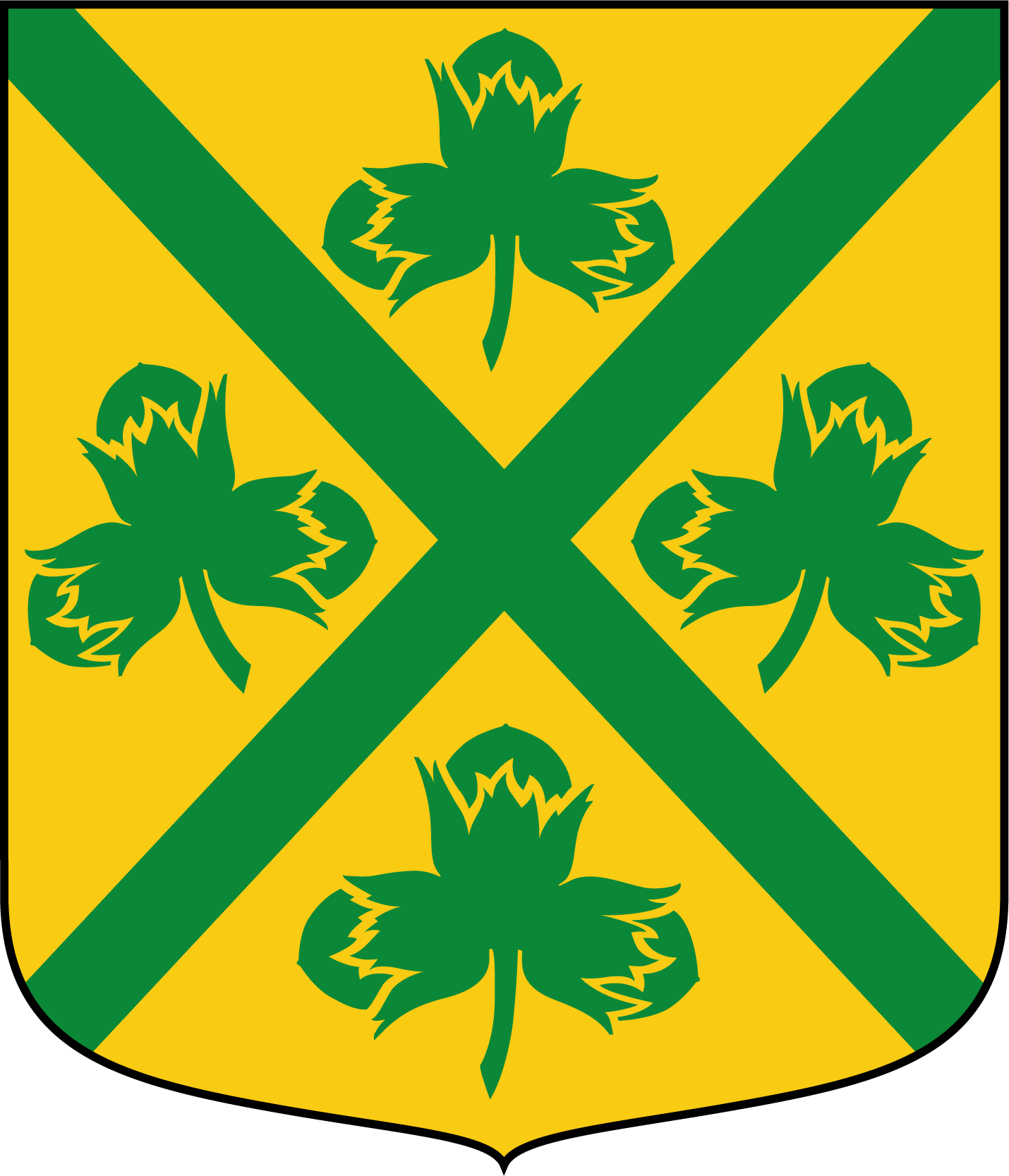

Coat of arms of Hässleholm
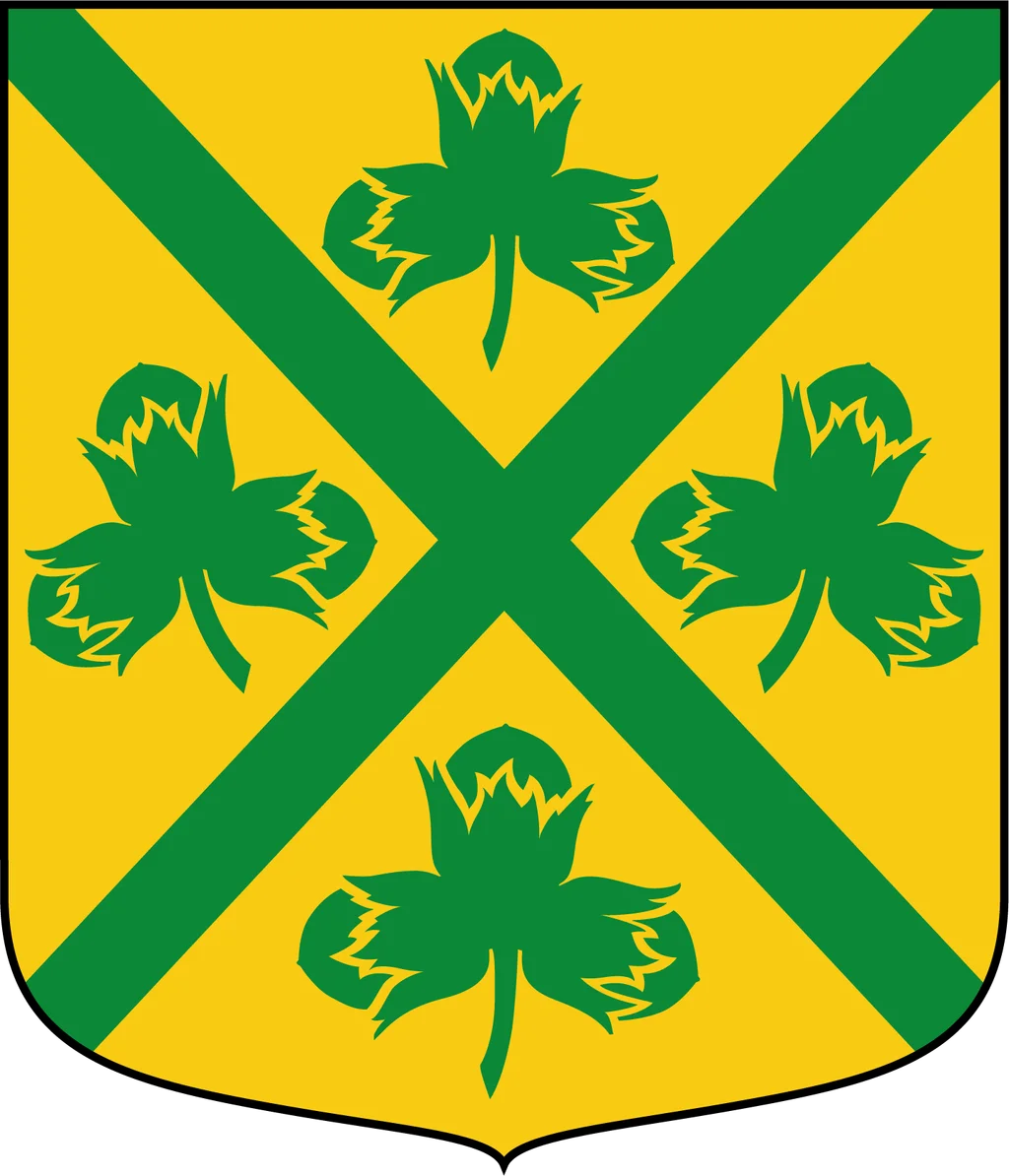
Hässleholm’s arms show a green saltire and four green hazel-nut clusters on a gold field.
Swedish description in the Heraldica record
I fält av guld ett grönt andreaskors i korsvinklarna åtföljt av fyra gröna trepass av hasselnötter.
This is the Swedish description in the Heraldica record. Its status as an official blazon has not been independently verified here. The municipality’s guideline gives the 1920 confirmation and explains the local associations of the motifs.
Designers
- Vladimir A. Sagerlund
Registration and history
- 25 September 1920: Royal confirmation on
- 15 March 1974: Registered at the National Board of Patents and Registration
Motifs and registry wording
The Heraldica record describes a green saltire and four green hazel-nut clusters, rendered as trefoils, on a gold field.
Source: Heraldica record 3074
The municipality’s explanation of the motifs
Hässleholm Municipality’s graphic guidelines say the arms’ description was confirmed in 1920 and that the current image is a stylised version of the original interpretation. The municipality explains the saltire as a reference to the town’s role as a railway junction. The nut clusters are associated with the first part of the place name, hässle, meaning a hazel grove.
Source: Hässleholms kommun: Riktlinjer för kommunens grafiska profil
Heraldic elements
The heraldic elements are identified using HERO, a heraldry ontology published through Finland's Finto service. It provides structured terminology for describing coats of arms and their components. The list describes the structure of the arms, not the symbolic meaning of its elements.
- escutcheon
- field
- Or
- bunch of three filberts
- Vert
- four
- saltire
- unpartitioned
Sources and image rights
Heraldica / National Archives of Finland · Wikidata
Image licence: CC BY-SA 3.0
Image source and credit: National Archives of Sweden / Vladimir Sagerlund
Original image. The image has been resized and converted to WebP. The derivative retains the original image’s licence.