What is the Sun of May on Argentina’s flag?
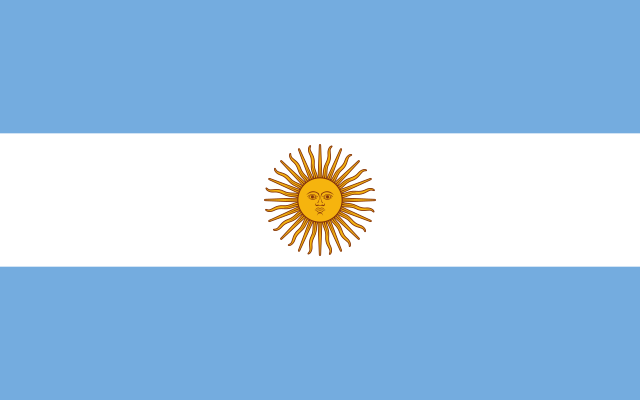
It is a golden sun with 32 alternating straight and wavy rays, placed in the centre of the white band.


Argentina’s national flag has three horizontal sky-blue and white bands, with a golden Sun of May in its official version. Its history spans the first raising in 1812 and later national standards.

Argentina
Information about the flag’s design, colours and proportions.
The flag has 3 horizontal bands from top to bottom: blue · white · blue.
Argentina’s flag has three equal horizontal bands: sky blue, white and sky blue. The official version includes the Sun of May at the centre of the white band. The government’s description specifies a golden sun with 32 alternating straight and wavy rays.
The detailed technical standard sets out the flag’s colours and construction, including the proportions used for the official design. The familiar band pattern can therefore appear with or without the sun, while the version bearing the emblem is the official national flag described by the government.
Manuel Belgrano created the flag and raised it for the first time in Rosario on 27 February 1812. The Congress of Tucumán later adopted its colours as the national flag on 20 July 1816. In 1818, the Sun of May was added to the white band, giving the official design its distinctive central emblem.
Argentina celebrates Flag Day on 20 June, the date of Belgrano’s death in 1820. The national observance was established in 1938, and a 2010 decree set the commemorative date as 20 June each year. The date thus honours the flag’s creator rather than the first raising in Rosario.
A 1985 law expressly recognises the right of national, provincial and municipal authorities, public bodies and private individuals to use the official national flag. A separate historical banner is the Flag of Civil Liberty, which Belgrano presented to the people of Jujuy in 1813 and which became a historic national symbol under a 2015 law.
The Flag of Civil Liberty is not a second version of the current national flag. The law recognises it as a distinct historical emblem, preserving the account of Belgrano’s 1813 gift while the sky-blue and white flag with the Sun of May remains Argentina’s national flag.
It is a golden sun with 32 alternating straight and wavy rays, placed in the centre of the white band.
Manuel Belgrano first raised it in Rosario on 27 February 1812. The Congress of Tucumán adopted its colours as the national flag in 1816.
The date marks Manuel Belgrano’s death on 20 June 1820. The annual national observance was established in 1938.
No. It is a separate historic banner presented by Belgrano to Jujuy in 1813 and recognised as a historic national symbol in 2015.
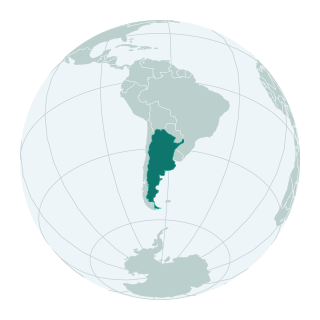
These flags come from the same region and share one or more design characteristics.
Images are ordered by the years listed in the collection. A listed year may not be the flag’s official adoption year.
Vexilla's historical flag collection includes former flags associated with present-day countries and territories, as well as flags of states, empires, and other authorities that historically governed them.
A flag's inclusion in a country's historical collection does not necessarily mean that the country was independent at the time or that the flag was its own national flag.
The years shown are based on historical records in the dataset and do not always indicate the date of official adoption. The collection is not exhaustive, and historical usage, territorial coverage, and interpretations may vary.


