What do the seven points of Australia’s Commonwealth Star represent?
Six points represent the states and the seventh represents Australia’s territories.


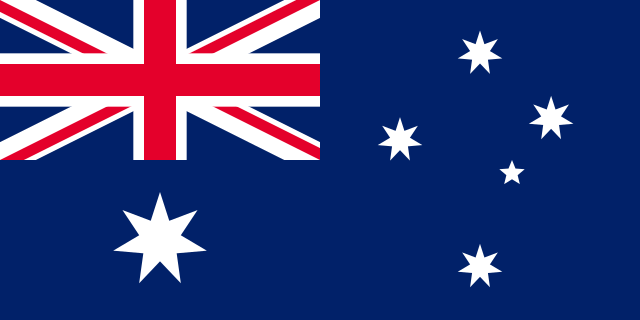
Australia’s flag combines a dark blue field with the Union Jack, the seven-pointed Commonwealth Star and five stars of the Southern Cross. Its present design grew from the winning entries in a 1901 competition and was given a statutory role in 1953.

Australia
Information about the flag’s design, colours and proportions.
The Union Jack occupies the upper-left canton beside the flagpole. Below it sits the Commonwealth Star. Five white stars on the fly form the Southern Cross, a constellation visible in the southern sky.
The Commonwealth Star has seven points. Six stand for the states and the seventh for the territories. The Southern Cross stars have different apparent sizes, reflecting the constellation’s principal stars rather than a row of identical emblems.
After the six colonies federated in 1901, the government invited designs for a national flag. More than 30,000 entries were submitted, and five similar designs were selected as joint winners. The winning flag was first flown on 3 September 1901, when the results were announced.
The original Commonwealth Star had six points, one for each state. A seventh point was added in 1908 to represent the territories. The flag’s current legal status came later, so the 1901 first flying and the 1953 legislation mark different stages in its history.
The Flags Act 1953 proclaimed the Commonwealth blue ensign as the Australian National Flag. The statute also designated the Commonwealth red ensign for Australian-registered merchant ships; the two flags share the same principal design but have different fields.
That legal distinction matters when identifying the national flag. The red ensign is part of Australia’s flag history and maritime practice, while the blue ensign is the national flag named by the Act. The government booklet also explains the symbols and their placement without requiring a single symbolic meaning for every star.
Six points represent the states and the seventh represents Australia’s territories.
The competition-winning design was first flown on 3 September 1901, when the results were announced.
The Flags Act 1953 proclaimed the blue ensign as the Australian National Flag and designated the red ensign for Australian-registered merchant ships.
The Australian Government’s flag booklet says the Union Jack acknowledges the history of British settlement in Australia.

These flags come from the same region and share one or more design characteristics.
Images are ordered by the years listed in the collection. A listed year may not be the flag’s official adoption year.
Vexilla's historical flag collection includes former flags associated with present-day countries and territories, as well as flags of states, empires, and other authorities that historically governed them.
A flag's inclusion in a country's historical collection does not necessarily mean that the country was independent at the time or that the flag was its own national flag.
The years shown are based on historical records in the dataset and do not always indicate the date of official adoption. The collection is not exhaustive, and historical usage, territorial coverage, and interpretations may vary.
 Valto Tunnus Symbols and visual analysis writer
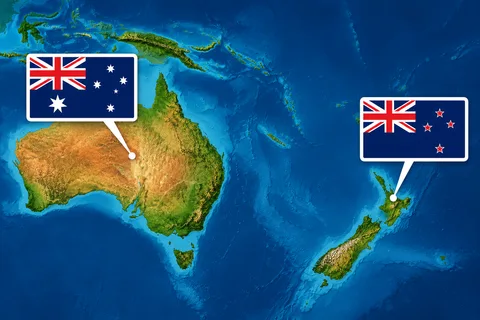
The flags of Australia and New Zealand look very similar: both feature the Union Jack and the Southern Cross. Learn the key differences and how to recognise each flag quickly.


