Can Bhutan’s flag be used as a wrapper or cover?
The 1972 Rules say the national flag must not be used as wrapping, covering, or a substitute for other cloth.


Bhutan’s flag places a white dragon across a diagonal divide between yellow and orange fields. Its proportions and symbolism are described in Bhutanese constitutional and official sources, while the design’s development is recorded through interviews with people involved.
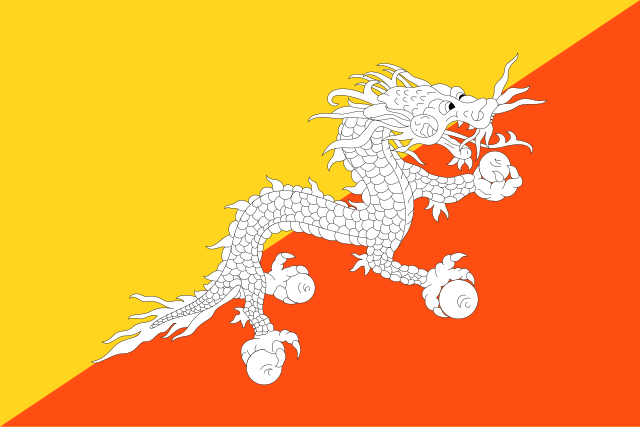

Bhutan
Information about the flag’s design, colours and proportions.
Bhutan’s flag is divided diagonally into yellow and orange fields, crossed by a white dragon known as Druk. Its body follows the diagonal boundary, so the dragon visually joins the two colours rather than sitting in a separate central badge.
Druk is Bhutan’s national emblem and is linked with the country’s name, Druk Yul, or “Land of the Thunder Dragon.” The Ministry of Foreign Affairs describes the Norbu jewels in the dragon’s claws as symbols of the country’s wealth and perfection.
The flag is divided diagonally from the lower hoist corner towards the upper fly. Yellow fills the upper triangle and orange the lower one; a white dragon follows the dividing line and reaches across both colours. The Constitution’s First Schedule describes the flag and its symbolism, and the published 1972 Rules give the design’s formal proportions.
Those Rules set the width at two-thirds of the length, a 3:2 length-to-width ratio. The ratio applies regardless of the flag’s size. It is a useful detail when distinguishing Bhutan’s long rectangular flag from square historical versions described in accounts of its earlier designs.
Bhutan’s constitutional description links yellow with the secular tradition and the King, and orange with the spiritual tradition and the Kagyu and Nyingma Buddhist teachings. The Ministry of Foreign Affairs’ 2022 guide gives the same broad interpretation, describing the colours as a pairing of royal authority and Buddhist practice.
The white Druk represents the country’s name and, in the Constitution, the loyalty and sense of belonging shared by people of different ethnic and linguistic origins. The Foreign Ministry also explains the dragon’s fierce expression as a sign of protective deities and the Norbu jewels in its claws as symbols of wealth and perfection.
A 2002 Centre for Bhutan Studies account, based on interviews with people involved in the flag’s development, traces an early version to the 1949 Indo-Bhutan Treaty signing. It describes a square yellow-and-red flag with a green dragon. For a royal journey in 1956, the account says the dragon was changed to white; the flag’s rectangular shape and diagonal dragon followed in a redesign in the late 1950s.
The same account places the change from a red lower field to orange in 1968 or 1969, following a royal command. It does not establish an exact adoption day for the current colours. The year 1969 is therefore best treated as an approximate point in the design’s history, rather than a precisely dated legal adoption.
The 1972 Rules say the national flag must not be used as wrapping, covering, or a substitute for other cloth.
The 1972 Rules say it must never be flown upside down and should not be hoisted lower than other flags.
They specify display from sunrise to sunset at the capital, the King’s palace, and civil service and armed forces premises.
The Rules say it must not be dragged on the ground or drenched with water, and call for care when it is raised or lowered.
Images are ordered by the years listed in the collection. A listed year may not be the flag’s official adoption year.
Vexilla's historical flag collection includes former flags associated with present-day countries and territories, as well as flags of states, empires, and other authorities that historically governed them.
A flag's inclusion in a country's historical collection does not necessarily mean that the country was independent at the time or that the flag was its own national flag.
The years shown are based on historical records in the dataset and do not always indicate the date of official adoption. The collection is not exhaustive, and historical usage, territorial coverage, and interpretations may vary.

