Why is a sisserou parrot shown on Dominica's flag?
The sisserou is Dominica's national bird; the ten surrounding stars refer to the country's parishes.


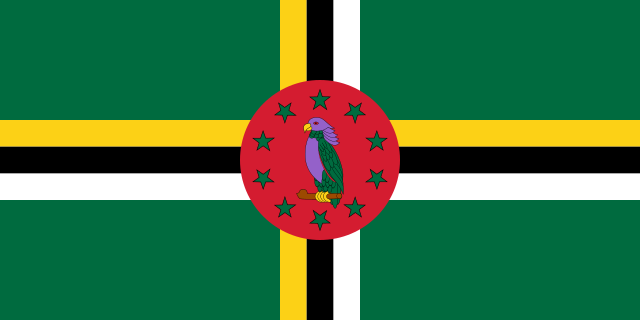
Dominica's flag has a green field crossed by three bands in yellow, black and white.

Dominica
Centred cross.
A sisserou parrot, Dominica's national bird, stands within ten stars for the country's parishes on a green field and cross.
A red disc at the centre bears the Sisserou parrot, surrounded by ten green stars. The Government identifies the stars with the country's ten parishes, which it describes as having equal status.
The Government also gives meanings to the colours: green for vegetation, yellow for sunshine, agriculture and the Kalinago and Arawak peoples, white for water, black for the soil and African heritage, and red for social justice. These are the government's stated explanations of the flag's symbolism.
The sisserou is Dominica's national bird; the ten surrounding stars refer to the country's parishes.
The centre shows the Sisserou parrot, Dominica's national bird.
They represent Dominica's ten parishes, which the Government describes as having equal status.
It links green with vegetation, yellow with sunshine, agriculture and Indigenous peoples, white with water, black with soil and African heritage, and red with social justice.

These flags come from the same region and share one or more design characteristics.
Images are ordered by the years listed in the collection. A listed year may not be the flag’s official adoption year.
Vexilla's historical flag collection includes former flags associated with present-day countries and territories, as well as flags of states, empires, and other authorities that historically governed them.
A flag's inclusion in a country's historical collection does not necessarily mean that the country was independent at the time or that the flag was its own national flag.
The years shown are based on historical records in the dataset and do not always indicate the date of official adoption. The collection is not exhaustive, and historical usage, territorial coverage, and interpretations may vary.

