Why does Jordan's star have seven points?
The seven points are often linked with the seven verses of the Quran's opening sura.


Jordan’s Constitution sets out exact measurements for the flag, including its 2:1 proportions and seven-rayed star. Official sources also trace its current form to 1922 and explain the colours and symbols.
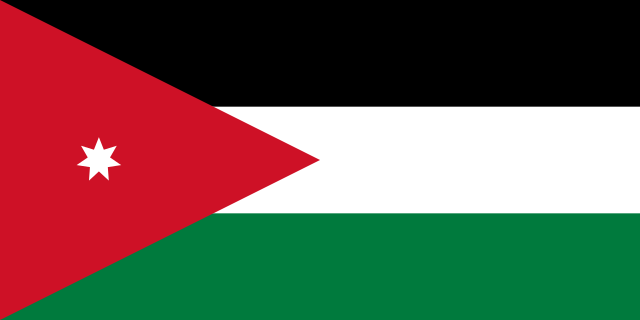

Jordan
Information about the flag’s design, colours and proportions.
The flag has 3 horizontal bands from top to bottom: black · white · green.
Jordan's Pan-Arab bands and red Hashemite triangle carry a seven-pointed star often linked with the seven verses of the Quran's opening sura.
Jordan’s Ministry of Culture connects the horizontal bands with Arab dynastic traditions: black with the Abbasids, white with the Umayyads and green with the Fatimids. The red triangle represents the Hashemites and brings the three bands together.
The white seven-rayed star refers to the seven verses of Al-Fatiha, the opening chapter of the Quran. The Ministry also describes its position inside the triangle as a reference to the Great Arab Revolt’s aspiration to unite Arab peoples.
Article 4 of Jordan’s Constitution specifies a length twice the width and three equal horizontal bands: black above, white in the middle and green below. A red triangle at the hoist has a base equal to the flag’s width and an altitude half its length.
The constitution also gives a measurable standard for the white star: its points fit within a circle whose diameter is one-fourteenth of the flag’s length. Its centre sits in the triangle, with one ray parallel to the triangle’s base.
The Ministry of Culture says the current form began to be used in 1922 and was formally adopted in the 1928 Basic Law of Transjordan. Its colours and layout draw on the banner of the Great Arab Revolt, which began in 1916.
Article 4 of the 1952 Constitution restated the flag’s form and measurements. The constitutional description makes the flag’s familiar design a defined national standard, not just a symbolic arrangement of colours.
The seven points are often linked with the seven verses of the Quran's opening sura.
Its length is twice its width, or a 2:1 ratio. The flag has three equal horizontal bands and a red triangle at the hoist.
Jordan’s Ministry of Culture connects its seven rays with the seven verses of Al-Fatiha, the opening chapter of the Quran.
The Constitution says its points fit within a circle with a diameter one-fourteenth of the flag’s length. The star is centred in the red triangle.
The current form began to be used in 1922 and was formally adopted in the 1928 Basic Law of Transjordan.
These flags come from the same region and share one or more design characteristics.
Images are ordered by the years listed in the collection. A listed year may not be the flag’s official adoption year.
Vexilla's historical flag collection includes former flags associated with present-day countries and territories, as well as flags of states, empires, and other authorities that historically governed them.
A flag's inclusion in a country's historical collection does not necessarily mean that the country was independent at the time or that the flag was its own national flag.
The years shown are based on historical records in the dataset and do not always indicate the date of official adoption. The collection is not exhaustive, and historical usage, territorial coverage, and interpretations may vary.


