What does the white stripe on Pakistan's flag represent?
It represents the country's religious minorities.


Pakistan’s flag was approved by the Constituent Assembly on 11 August 1947. Official instructions set its 3:2 proportions, the width of the white hoist stripe and the geometry of the crescent and star.
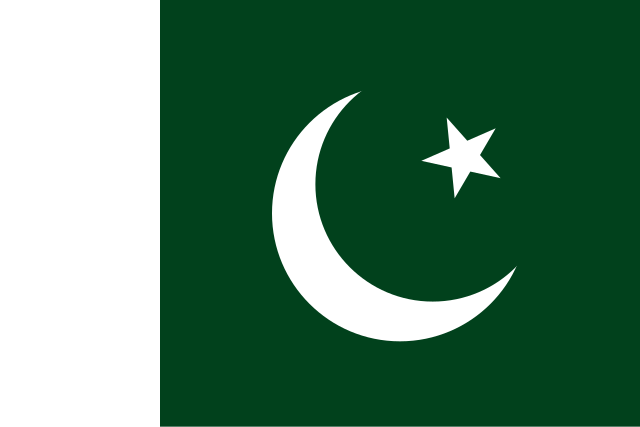

Pakistan
Information about the flag’s design, colours and proportions.
The flag has 2 vertical bands from hoist to fly: white · green.
Pakistan's dark-green field bears a white crescent for progress and star for light and knowledge, beside a white minority stripe.
Pakistan’s Constituent Assembly approved the national flag on 11 August 1947, according to the Cabinet Division’s record of the resolution. The approved design paired a dark green field with a white stripe at the mast and a crescent and star.
The resolution described the flag of the Federation of Pakistan before independence. The Cabinet Division’s later instructions continue to identify that Assembly-approved design as the standard national flag.
The official instructions set the flag’s length-to-width ratio at 3:2. The white vertical section occupies one-quarter of the flag at the mast, while the remaining three-quarters is dark green.
The crescent and five-pointed heraldic star are white and sit within the green portion. This gives the flag a clear visual balance between the hoist-side stripe and the larger field.
The instructions specify a geometric method for placing the crescent and star within the green field. It uses a diagonal running from the upper right to the lower left of that section as a reference for their dimensions and placement.
The star is a five-pointed heraldic star, and the crescent is formed by two arcs. These construction details distinguish the official design from a loosely drawn crescent-and-star motif.
It represents the country's religious minorities.
The Constituent Assembly of Pakistan approved the national flag on 11 August 1947, three days before independence.
The official instructions give a length-to-width ratio of 3:2, equivalent to a width-to-height ratio of 2:3.
The white stripe next to the mast occupies one-quarter of the flag; the dark green section makes up the other three-quarters.
The official instructions define their dimensions and placement geometrically within the green field, using its diagonal as a reference.
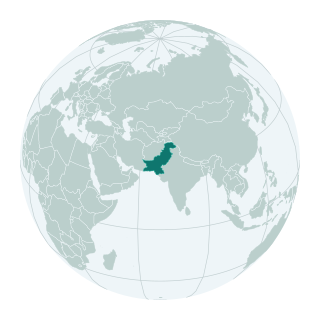
These flags come from the same region and share one or more design characteristics.
Images are ordered by the years listed in the collection. A listed year may not be the flag’s official adoption year.
Vexilla's historical flag collection includes former flags associated with present-day countries and territories, as well as flags of states, empires, and other authorities that historically governed them.
A flag's inclusion in a country's historical collection does not necessarily mean that the country was independent at the time or that the flag was its own national flag.
The years shown are based on historical records in the dataset and do not always indicate the date of official adoption. The collection is not exhaustive, and historical usage, territorial coverage, and interpretations may vary.


