What is the design of Trinidad and Tobago’s flag?
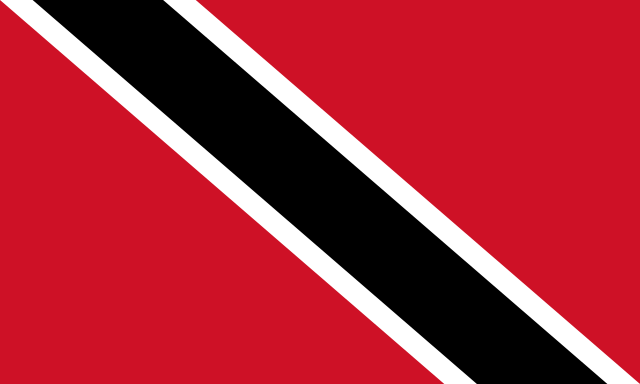
It has a red field crossed by a black diagonal band bordered in white.


Selected from designs prepared for independence in 1962, the flag combines a red field with a white-edged black diagonal band.

Trinidad and Tobago
Information about the flag’s design, colours and proportions.
The National Identity Guidelines describe a black diagonal band bordered in white on a red field. They set a 5:3 proportion for flags flown on land and 2:1 for flags flown at sea, so the context matters when comparing flag shapes.
The Ministry of Foreign Affairs explains the colours through the country’s stated national symbolism: black for dedication and unity, red for vitality and courage, and white for the sea, heritage, purity of aspiration and equality. The three colours also represent earth, water and fire.
It has a red field crossed by a black diagonal band bordered in white.
The official guidelines give 5:3 for flags flown on land and 2:1 for flags flown at sea.
Official guidance associates black with dedication and unity, red with vitality and courage, and white with the sea, heritage and equality.

These flags come from the same region and share one or more design characteristics.
Images are ordered by the years listed in the collection. A listed year may not be the flag’s official adoption year.
Vexilla's historical flag collection includes former flags associated with present-day countries and territories, as well as flags of states, empires, and other authorities that historically governed them.
A flag's inclusion in a country's historical collection does not necessarily mean that the country was independent at the time or that the flag was its own national flag.
The years shown are based on historical records in the dataset and do not always indicate the date of official adoption. The collection is not exhaustive, and historical usage, territorial coverage, and interpretations may vary.
