What is shown on Maryland’s flag?
The quartered field combines the black-and-gold Calvert arms with a red-and-white cross design identified as Crossland in official sources.


State flag
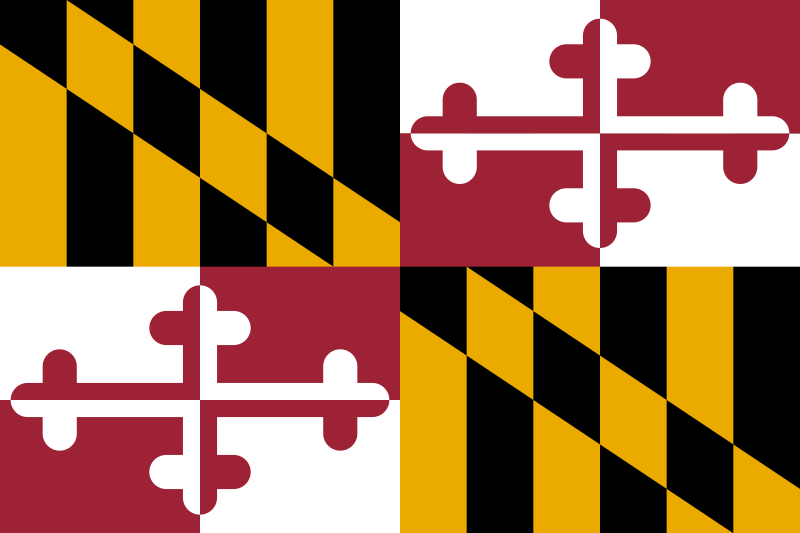
Maryland’s flag brings the black and gold of the Calvert arms together with a red-and-white cross design in a quartered field. Its heraldic pattern connects the family that held the colonial proprietorship with the state’s later history.
This is the flag of the U.S. state of Maryland.
Visible features:
The flag facts below are supported by the linked source.
The flag is divided into four quarters. The first and fourth show six alternating black and gold vertical bars from the Calvert arms with a diagonal band whose colors are reversed; the second and third have a red-and-white field charged with a cross bottony.
A 1904 law specifies the arrangement and heraldic details. On flags, gold is rendered as yellow and silver as white, so heraldic metal terms do not always match everyday color names.
Black and gold are the arms’ Calvert colors. The Calverts were members of the Lords Baltimore family, which held Maryland’s colonial proprietorship. The red, white and cross design is usually associated with the maternal family of George Calvert, called Crossland in Maryland’s official sources.
Sources differ on the family name: a 2023 Maryland State Archives history attributes the red-and-white arms to George Calvert’s wife, Anne Mynne, while the Secretary of State’s history and the 1904 law use Crossland. The names should therefore not be presented as wholly undisputed.
The quartered design is documented by 1880, when it appeared in a parade marking Baltimore’s 150th anniversary. It was also seen at Gettysburg in 1888, and the Maryland National Guard’s Fifth Regiment adopted it as its regimental color in 1889. Maryland made it the state flag on March 9, 1904.
During the Civil War, the black-and-gold Calvert emblem was associated with Unionist Maryland, while some Southern sympathizers used the red-and-white Crossland design. The present flag is often read as a symbol of reconciliation and unity, but neither its original designer nor original intent is known, so that reading cannot be treated as a confirmed original message.
Source: History of the Maryland Flag,History of Maryland’s Flag,Chapter 48, Acts of 1904
The flag is recognized by its alternating black-and-gold and red-and-white quarters. Unlike many state flags, its whole field consists of heraldic family designs rather than a central seal, animal or lettering.
Maryland law requires any ornament attached to the top of a flagstaff carrying the state flag to be a gold cross bottony. This rule concerns the staff ornament, not the design on the flag itself.
Source: Chapter 48, Acts of 1904,History of the Maryland Flag
The quartered field combines the black-and-gold Calvert arms with a red-and-white cross design identified as Crossland in official sources.
The first and fourth quarters show Calvert’s black and gold bars with a color-reversed diagonal band. The second and third contain a red-and-white field and a cross bottony.
The Maryland General Assembly adopted it by law on March 9, 1904. The design had appeared publicly by at least 1880.
It is often interpreted as bringing together Union and Southern supporters. Archives sources say the original designer and intent are unknown, however.
The law specifies a gold cross bottony. It is a staff ornament, not part of the flag’s cloth design.