 Idaho
 Alaska
 Arkansas
What is on New Mexico’s flag?
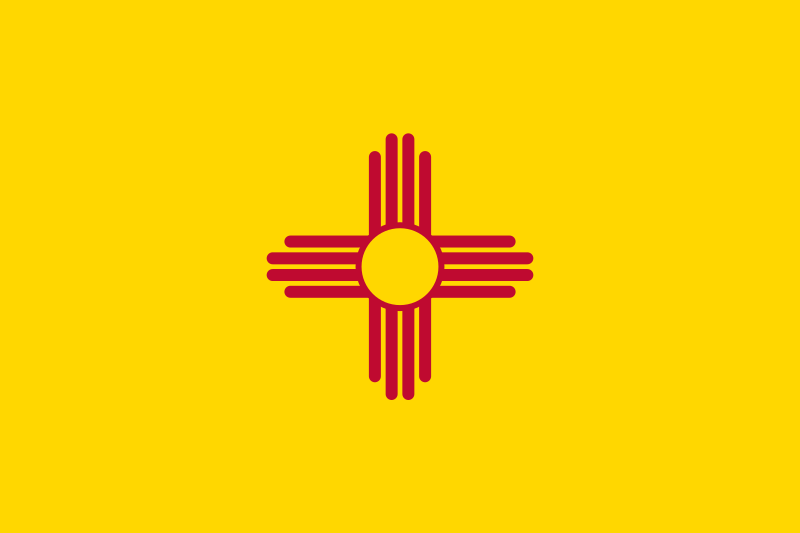
A red Zia sun with four groups of four rays appears on a yellow field.


State flag
New Mexico’s flag is known for a simple red Zia sun on a yellow field. It is both a design defined in state law and a symbol connected to the cultural heritage of Zia Pueblo.
This is the flag of the U.S. state of New Mexico.
Visible features:
The flag facts below are supported by the linked source.
A red Zia sun appears at the center of a yellow field. The 1925 law specifies the colors as the red and yellow of old Spain and sets the flag’s width at two-thirds of its length.
The sun symbol is one-third of the flag’s length. Its four groups of rays meet at right angles; each group has four rays, with the two inner rays one-fifth longer than the outer ones. The central circle’s diameter is one-third of the symbol’s width.
Source: New Mexico Statutes § 12-3-2 (Laws 1925, ch. 115, § 1),State Flag
The state’s official account connects the flag design to a sun motif on a late-19th-century water jar from Zia Pueblo. On the flag, a circle sends four groups of rays toward the four cardinal directions.
New Mexico’s official explanation associates the number four with the directions, seasons, parts of the day and stages of life. It also describes four obligations: a strong body, a clear mind, a pure spirit and devotion to the welfare of one’s people. This is the state’s published interpretation, not an exhaustive account of Zia Pueblo tradition.
New Mexico’s first state flag was adopted in 1915. Designed by Ralph Emerson Twitchell, it had a dark blue field, a small U.S. flag, the state seal and “New Mexico” sewn diagonally across it.
The New Mexico chapter of the Daughters of the American Revolution held a design competition in 1923. Physician and archaeologist Harry Mera won; his wife, Reba, created the winning design, with a red Zia on yellow. Governor Arthur T. Hannett signed it into law in March 1925.
Source: State Flag,New Mexico State Legislature Handbook: State Flag
The 1925 law calls red and yellow the colors of old Spain. The state’s official history also connects them to Isabella I of Castile and the Spanish colonial period.
The colors are part of the design specified by law, not merely decoration. The Zia motif, in turn, is drawn from a symbol associated with Pueblo of Zia. Their presence together reflects the state’s official way of presenting several historical traditions, but does not by itself resolve the tensions between them.
Source: New Mexico Statutes § 12-3-2 (Laws 1925, ch. 115, § 1),State Flag
The Zia design did not originate as a general state emblem. A 1999 New Mexico legislative memorial recognized it as a sacred symbol of the Zia people and stated that Pueblo of Zia had not authorized its use on the state flag.
The memorial expressed regret for the unauthorized use and called for negotiations concerning the symbol’s sacred status, compensation for its use and continued use on the state flag. This official record is an essential part of the flag’s history; the symbol should not be reduced to decoration or a simple “blend of cultures.”
Source: House Joint Memorial 88 (1999)
A red Zia sun with four groups of four rays appears on a yellow field.
The state’s official explanation connects it with the directions, seasons, parts of the day, stages of life and four obligations to one’s community.
The current design was adopted as the state flag in 1925.
Reba Mera created the winning design. Her husband, physician and archaeologist Harry Mera, won the competition.
The 1925 law identifies them as the colors of old Spain; the state’s official account also links them to Isabella I of Castile.
According to a 1999 state legislative memorial, Pueblo of Zia had not authorized it. The memorial recognized the symbol’s sacred status and called for negotiations.