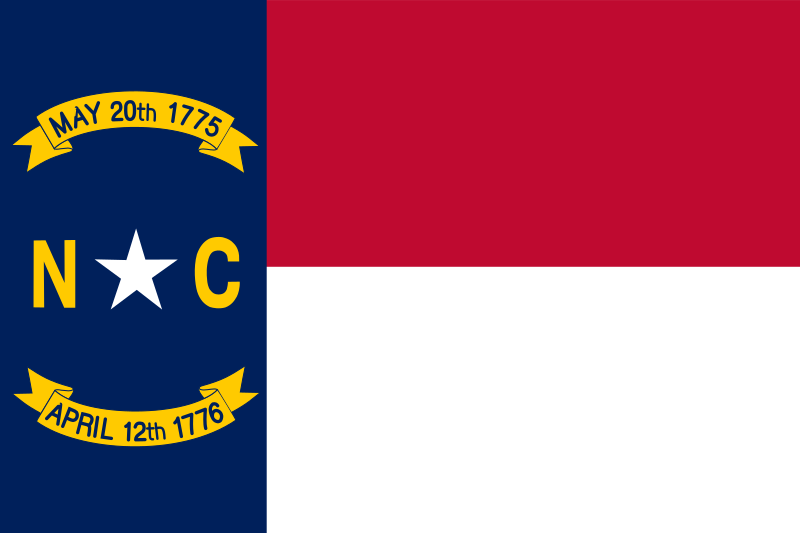
North Carolina’s flag is recognized by its blue vertical panel, white star and gilt N and C on either side. Gilt scrolls above and below the star carry dates from 1775 and 1776. They do not refer to events with the same historical standing: the Halifax Resolves are documented, while the authenticity of the Mecklenburg Declaration is disputed.
This is the flag of the U.S. state of North Carolina.
Flag of North Carolina (US-NC)
About the state
State name
North Carolina
Type
State
Capital
Raleigh
ISO 3166-2
US-NC
Joined the Union
1789
Flag design
Visible features:
stripes
stars
text or lettering
What does North Carolina’s flag look like?
State law specifies a blue union at the hoist, with a white star centered in it. A gilt N sits to the star’s left and a gilt C to its right. Curved gilt scrolls above and below bear the inscriptions May 20th 1775 and April 12th 1776 in black. The fly has two equal horizontal bars, red above white. Since a 1991 amendment, the flag is one and a half times as long as it is wide, a 3:2 proportion.
April 12th 1776 refers to the Halifax Resolves. On that date, North Carolina’s Fourth Provincial Congress authorized the colony’s delegates to vote for independence in the Continental Congress; the General Assembly Library describes this as the first official action by any of the thirteen colonies toward independence from Britain. May 20th 1775 is traditionally associated with the Mecklenburg Declaration of Independence. Its alleged text surfaced only in 1819, and current scholarship generally considers the declaration likely spurious. The Mecklenburg Resolves adopted on May 31, 1775, are a separate, documented event.
A flag was issued to North Carolina troops in 1861. Its second date was May 20th 1861, commemorating the state’s secession from the Union at the start of the Civil War. In 1885, the General Assembly adopted a new flag and replaced that date with April 12th 1776, for the Halifax Resolves. The basic design dates to 1885. The 1991 law did not replace its main symbols; it changed the flag’s proportions and removed punctuation from the dates in the statutory wording.
What do the dates on North Carolina’s flag represent?
April 12th 1776 marks the Halifax Resolves, which authorized the colony’s delegates to vote for independence. May 20th 1775 is traditionally linked to the Mecklenburg Declaration, whose authenticity is doubted by current scholarship.
Is the Mecklenburg Declaration definitely authentic?
No. Its alleged text was published only in 1819, and no original document survives. NCpedia’s historical account says modern scholars generally do not accept it as authentic; the Mecklenburg Resolves of May 31, 1775, are a distinct, documented event.
What changed on North Carolina’s flag in 1991?
A 1991 law made the flag one and a half times as long as it is wide and removed commas from the dates. The blue panel, star, N and C, scrolls, and red and white bars remained.


 Texas
 Colorado
 Georgia