 Idaho
 Kansas
 Montana
What makes Oregon’s flag unusual?
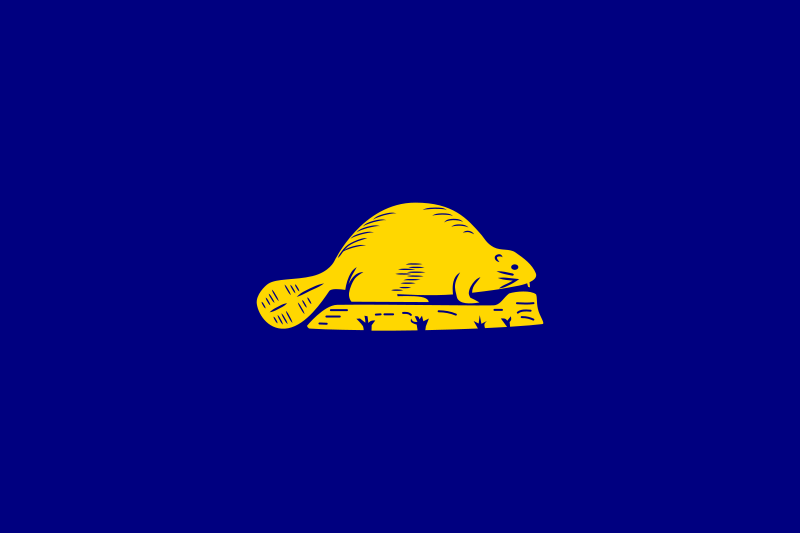
Its front and reverse have different designs: the seal escutcheon and lettering on one side, and a beaver on the other.


State flag
Oregon’s two-sided design is specified in state law: the seal device belongs on the front and a beaver on the reverse. Adopted in 1925, the flag uses the state colors, navy blue and gold.
This is the flag of the U.S. state of Oregon.
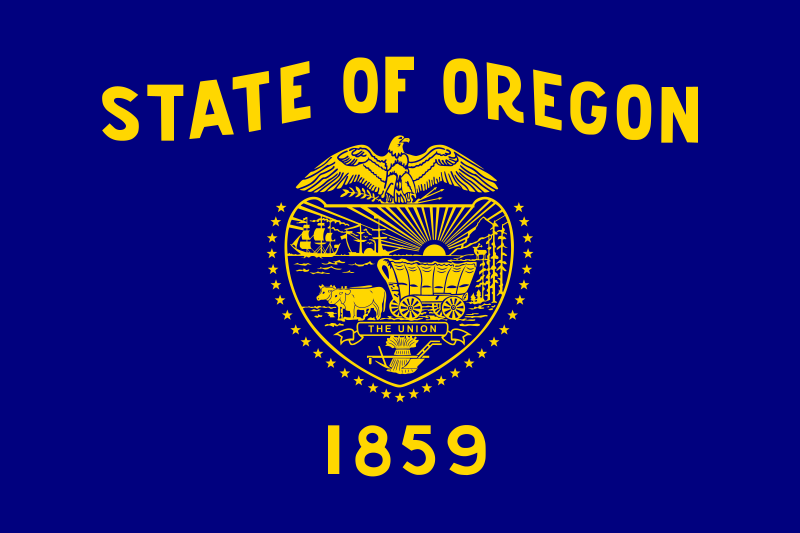
Visible features:
The flag facts below are supported by the linked source.
Oregon’s flag is unique among U.S. state flags: its front bears the escutcheon from the state seal, while its reverse shows a gold beaver. Both sides use a navy-blue field, making the two distinct images parts of one flag.
This arrangement is written into law, not left to a maker’s choice. Oregon’s statute specifies a gold seal device on one side and a gold beaver on the other.
Source: Oregon Revised Statutes § 186.010–186.020: State flag and state seal,Oregon State Flag
The central element is the escutcheon from Oregon’s state seal. “State of Oregon” appears above it in gold, with “1859” below—the year Oregon entered the Union as its 33rd state. Thirty-three five-pointed stars support the escutcheon.
The seal’s details bring together landscape, transport and work: the statute lists mountains, an elk, a wagon and the Pacific, where a British man-of-war departs as an American steamer arrives. A sheaf, plow and pickax appear below, with an American eagle above.
Source: Oregon Revised Statutes § 186.010–186.020: State flag and state seal,Oregon Almanac: Flag, State
The reverse shows a gold beaver perched on a log. The animal is tied to Oregon’s longstanding “Beaver State” identity and the history of the fur trade. The Oregon Encyclopedia recounts a contemporary newspaper’s explanation that beavers were important to early exploration and the regional fur trade; it also cited thrift and industry as qualities associated with the animal.
Those are historical explanations, not a statutory interpretation of every emblem. The law itself specifies the image: a gold beaver on a navy-blue field on the reverse.
Source: Oregon Revised Statutes § 186.010–186.020: State flag and state seal,Oregon State Symbols
Oregon adopted its state flag on February 26, 1925. After Governor Walter M. Pierce signed the bill, Adjutant General George A. White asked Portland’s Meier & Frank department store to make the first flag. Seamstresses Blanche Cox and Marjorie Kennedy completed it for a state-flag display that spring.
The law names navy blue and gold as the official colors. The official height-to-width proportion is 500:833, though 3:5 and 2:3 are also common in practice. A dress or parade version may have gold fringe; that is distinct from the plain border of a utility flag.
Its front and reverse have different designs: the seal escutcheon and lettering on one side, and a beaver on the other.
It marks Oregon’s admission to the United States in 1859 as the 33rd state.
They represent Oregon’s place as the 33rd state to join the Union.
The state legislature adopted it on February 26, 1925.
A gold beaver perched on a log against a navy-blue field.
Oregon law names navy blue and gold as the state’s official colors.