 Maine
 Michigan
 New York
What is on Pennsylvania’s flag?
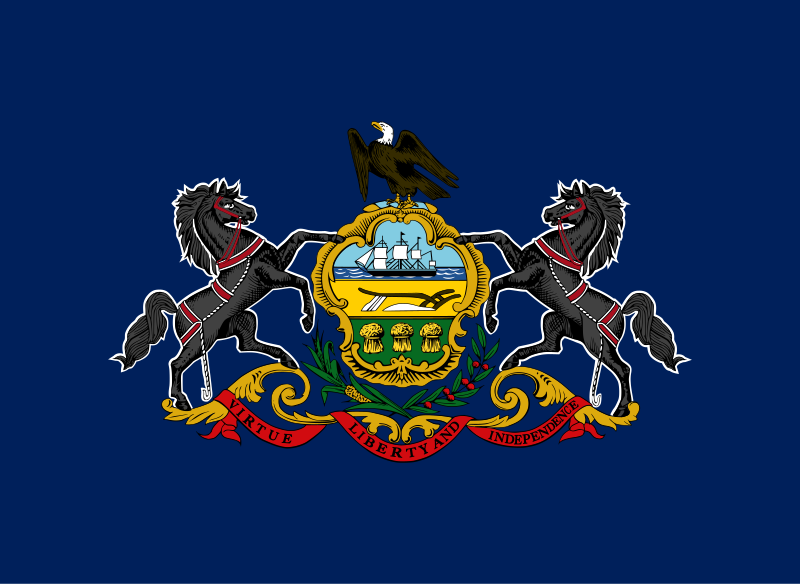
A blue field bears the Commonwealth’s coat of arms: a ship, plow, three wheat sheaves, an eagle, two horses and the motto.


State flag
The flag centers the state coat of arms, which is distinct from the state seal used to authenticate documents. Its emblems connect commerce and agriculture with the Commonwealth’s motto; the flag’s design was standardized by law in 1907.
This is the flag of the U.S. state of Pennsylvania.
Visible features:
Pennsylvania’s flag has a blue field with the Commonwealth’s coat of arms embroidered in the center. The law requires the same arms on both sides. The coat of arms and state seal are related but distinct: the arms have two horses flanking the shield and an eagle above, features absent from the seal’s shield device.
The Pennsylvania Manual describes the coat of arms as a familiar symbol of the Commonwealth. The state seal, by contrast, is used to authenticate official documents. Its shield shares the ship, plow and wheat emblems, but the seal has a different purpose and overall design.
Source: The Pennsylvania Manual, Volume 127: State Seal, Coat of Arms and State Flag,Act of June 13, 1907, P.L. 560, No. 373: Flag of Pennsylvania Designated
The shield is divided into three sections: a sailing ship at the top, a plow in the middle and three sheaves of wheat below. Pennsylvania’s official visitor guide connects the ship with commerce, the clay-red plow with natural resources, and the wheat with fertile fields and wealth.
The sheaves also suggest wealth created through human thought and action. These meanings come from the Commonwealth’s own descriptions; the law specifies the flag and arms but does not interpret every element in the same way.
Source: The Pennsylvania Manual, Volume 127: State Seal, Coat of Arms and State Flag,Historical Highlights: State Symbols
A bald eagle spreads its wings above the shield, and two black horses support it at the sides. Beneath the shield, an olive branch and a cornstalk cross. Pennsylvania’s official guide describes the branches as conveying peace and prosperity.
The horses are heraldic supporters. State sources describe their placement and appearance but do not assign them one confirmed, specific meaning. They should not be given generic interpretations such as strength or agriculture without evidence.
Source: The Pennsylvania Manual, Volume 127: State Seal, Coat of Arms and State Flag,Historical Highlights: State Symbols
The red ribbon reads “Virtue, Liberty and Independence.” The motto is part of the coat of arms, based on a design Caleb Lownes created in 1778. The Pennsylvania House Archives says the legislature adopted a nearly identical official version of the arms in 1875.
The General Assembly authorized a state flag bearing the arms in 1799. Regiments also carried variations during the Civil War. The 1907 act standardized the official flag: its blue field was to match the blue of the U.S. flag, and the coat of arms was embroidered the same on both sides.
Source: Historical Highlights: State Symbols,Act of June 13, 1907, P.L. 560, No. 373: Flag of Pennsylvania Designated
A blue field bears the Commonwealth’s coat of arms: a ship, plow, three wheat sheaves, an eagle, two horses and the motto.
It shows the coat of arms. It shares shield emblems with the state seal but also has the horses and eagle.
The state’s official guide links them to commerce, natural resources, fertile fields and wealth.
“Virtue, Liberty and Independence” names the Commonwealth’s three stated ideals.
The General Assembly authorized a state flag with the coat of arms in 1799; a 1907 act standardized it.
It defined the blue field, the arms on both sides, yellow silk fringe and other construction details.