 Connecticut
 Kentucky
 Nevada
What is on South Carolina’s flag?
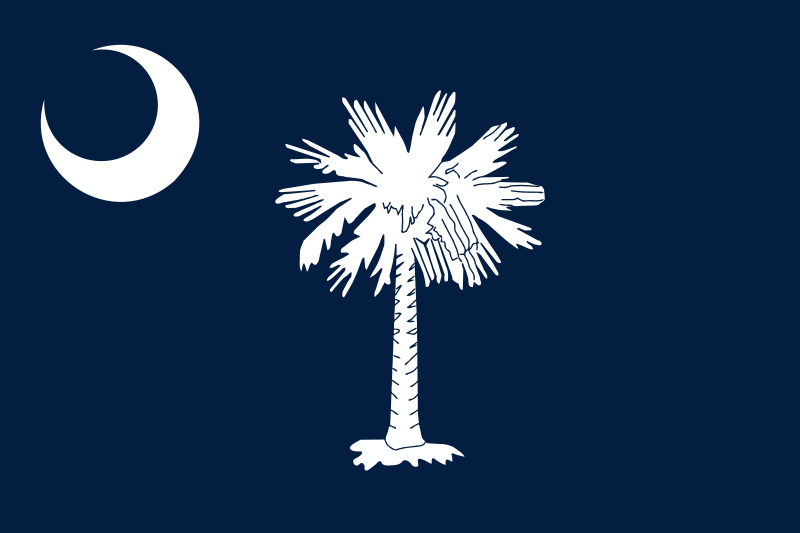
A white palmetto and a white crescent appear on a dark blue field, with the crescent in the upper hoist corner.


State flag
The flag brings together two moments: the blue banner used by William Moultrie’s troops in 1775 and the defense of Sullivan’s Island in 1776. The palmetto was added to the state flag in 1861.
This is the flag of the U.S. state of South Carolina.
Visible features:
The flag has a dark blue field, a white crescent in the upper hoist corner, and an upright white palmetto near the center. The present flag has no wording or state seal.
On January 28, 1861, the General Assembly adopted the palmetto as part of the flag. It was added to the blue-and-white crescent design associated with the troops of William Moultrie.
Source: South Carolina State Symbols,South Carolina State Flag Study Committee: Final Report
The palmetto recalls the fort on Sullivan’s Island that Moultrie defended against the British fleet on June 28, 1776. The fort was built with palmetto trunks, sand and clay.
The resilient trunks helped the fort withstand cannon fire: they flexed and absorbed impacts instead of breaking apart like ordinary timber. The battle became a notable Revolutionary War victory, and the palmetto became an enduring state emblem.
William Moultrie later recalled that he designed a flag for his troops in 1775. He chose blue to match their uniforms, and the white crescent echoed the silver crescent-shaped badge worn on the front of their caps.
The crescent has been interpreted in different ways—as a moon or as an emblem associated with the military gorget. Contemporary descriptions call it a silver crescent. The most precise neutral term is therefore crescent, rather than a sickle-shaped tool.
Source: South Carolina State Symbols,SC250 Activity Booklet,South Carolina State Flag Study Committee: Final Report
South Carolina approved secession from the United States on December 20, 1860. The General Assembly adopted a new flag the following month. Its January 28 resolution described a blue field, a white palmetto at the center and a white increscent in the upper hoist corner.
Indigo blue, worn by Moultrie’s soldiers, was designated the state’s official color in 2008. A later state flag study documented historical variations in color and form and recommended a uniform design; that report is a historical recommendation, not the original 1861 resolution.
Source: South Carolina State Flag Study Committee: Final Report,South Carolina State Symbols,South Carolina Code § 1-1-710: Official State Color
A white palmetto and a white crescent appear on a dark blue field, with the crescent in the upper hoist corner.
It recalls the palmetto-log fort on Sullivan’s Island and its defense against a British attack in 1776.
It echoes the silver crescent-shaped badge worn on Moultrie’s soldiers’ caps. Its exact interpretation as a moon or a gorget-related emblem has varied.
The General Assembly adopted the present basic design, with a palmetto and crescent, on January 28, 1861.
Blue matched the uniforms of Moultrie’s troops. Indigo is designated as the state’s official color.
It is a crescent, not an agricultural sickle. Its model is described as a silver crescent-shaped badge worn on soldiers’ caps.