 Maine
 Michigan
 New York
When did Vermont adopt its current flag?
The blue flag with the state coat of arms was made official in 1923.


State flag
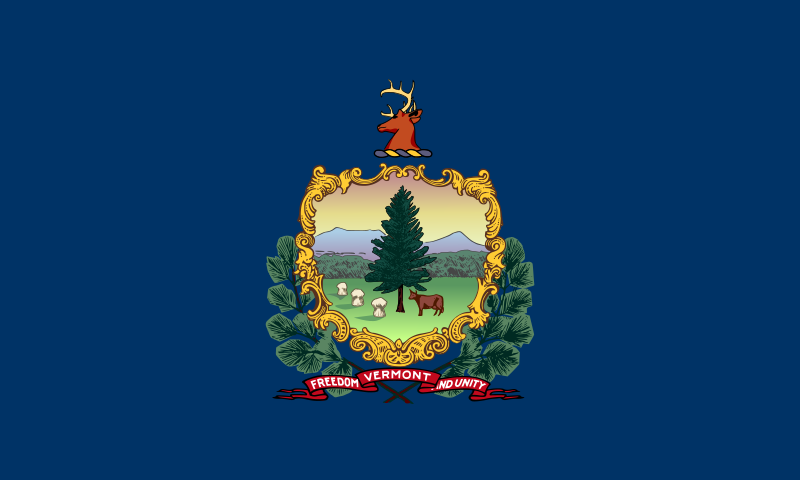
Vermont’s flag is a blue banner bearing the state coat of arms: a detailed landscape with a pine tree, sheaves and a red cow. The familiar design emerged through several earlier flags, and the law distinguishes the coat of arms on the flag from Vermont’s Great Seal.
This is the flag of the U.S. state of Vermont.
Visible features:
Vermont law defines the state flag simply: a blue field with the state coat of arms on it. The flag statute does not specify proportions or a separate arrangement of the arms.
A closer description comes from the law governing the coat of arms itself. It describes a landscape on a shield, with a pine tree, three yellow sheaves and a red cow beneath blue mountains and a yellow sky.
Source: 1 V.S.A. §§ 491 and 495, Coat of Arms and State Flag
The shield’s green landscape occupies half its area. A natural-coloured pine rises nearly to its top, between three yellow sheaves; a red cow stands on the other side, with high blue mountains behind them.
Below the shield is a scroll bearing “Vermont; Freedom and Unity,” with two crossed pine branches between the shield and scroll. The law describes these elements but does not assign each one a separate symbolic meaning.
Source: 1 V.S.A. §§ 491 and 495, Coat of Arms and State Flag
Vermont’s first state militia flag dates to 1803. It had 17 stripes and 17 stars, reflecting the number of states at the time, and displayed the word “VERMONT.”
In 1837, the legislature authorized a design with 13 red-and-white stripes and a large white star on a blue field containing the coat of arms. Historical accounts say it saw little use; Vermont regiments instead carried the arms on a blue field.
Source: Vermont History: The State Flag,Vermont Legislative Directory and State Manual (2023), History of the Vermont State Flag
The blue-field design was formally made Vermont’s state flag in 1923. Its use had grown from the banner carried by Vermont regiments and used by the governor, and it was more distinct from the United States flag.
The state flag is not the same as Vermont’s Great Seal, the Bennington Battle Flag or the Green Mountain Boys Flag. State law treats these as distinct emblems and flags.
Source: Vermont History: The State Flag,Vermont Legislative Directory and State Manual (2023), History of the Vermont State Flag,1 V.S.A. §§ 491 and 495, Coat of Arms and State Flag
The blue flag with the state coat of arms was made official in 1923.
A blue field bears the state coat of arms: a landscape with a pine tree, three sheaves, a red cow, mountains and the motto “Freedom and Unity.”
No. The flag bears the state coat of arms. The Great Seal is a separate emblem, although the two have historical connections.
An 1803 militia flag and a striped design authorized in 1837 preceded the blue-field flag. The earlier striped design was little used.