
Why does Ireland’s old flag feature a winged woman and a golden harp?
 Aarne Arkisto Historical emblems writer
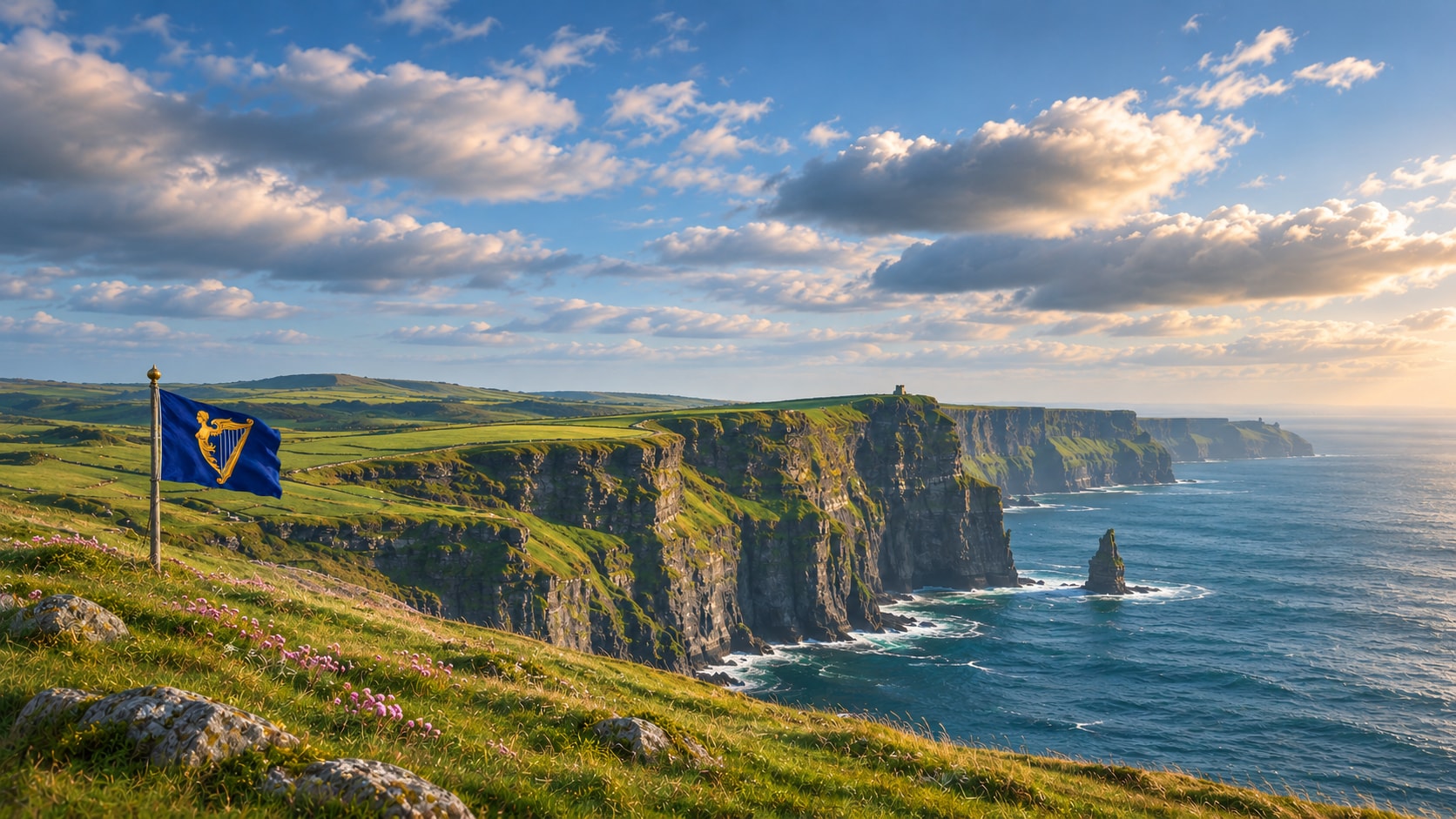
Ireland’s historic blue harp flag features a golden harp whose forepillar takes the form of a winged woman. The image may look mythological, but it is primarily a decorative variation of Ireland’s centuries-old heraldic emblem. The harp was a symbol of Ireland as early as the Middle Ages; the winged woman entered its imagery later.
The blue harp flag is associated especially with the Kingdom of Ireland (1542–1801). The same tradition also gave rise to green harp flags used as symbols by Irish national movements. Although the modern flag of Ireland is a green, white and orange tricolour, the harp survives in the state coat of arms and presidential standard.

What is Ireland’s blue harp flag?
In heraldic terms, its design is simple: a golden harp on a blue field. The traditional blazon of Ireland’s arms is Azure, a harp Or, stringed Argent—a golden harp with silver strings on blue. When the armorial device occupies the entire flag, this is a banner of arms, not necessarily a national flag in the modern sense.
In the early 1540s, under Henry VIII, Ireland’s status was changed to that of a kingdom. The year 1542 is often used as the starting point for the history of its royal harp banner. In 1801 the Kingdom of Ireland was united with the Kingdom of Great Britain. Historical reconstructions are therefore often labelled 1542–1801. That does not mean a single, identical illustration of the flag was the only design in use throughout that period.
You can also explore the flag on Vexilla’s historic Irish harp flag page. The year 1542 relates to the history of the Kingdom of Ireland; it does not establish that this particular detailed depiction of the harp was already in use at the time.
Why is there a winged woman on Ireland’s historic harp?
The winged woman is not an independent emblem placed in the middle of the flag. Her body forms the harp’s forepillar, and her wings extend into its upper section. The design is so elaborate that the harp can initially look like a combination of a person and a musical instrument.
Depictions of the harp evolved over the centuries. Early versions had a relatively plain forepillar. Later it acquired decorations resembling an animal’s head and eventually a female figure. According to the Irish coin imagery discussed by vexillologists Geoff Parsons and Michael Faul, a female torso appeared on royal coins during the reign of Charles II in the second half of the seventeenth century. Music historian Mary Louise O’Donnell describes the same development in three stages: a plain harp, an animal-headed ornament and the winged-maiden harp.
This decorative design is called the winged-maiden harp and sometimes the Maid of Erin harp. Erin is a poetic name for Ireland. The woman can thus be associated with personifications of Ireland, but it would be unjustified to claim that she certainly depicts a particular goddess or that her wings have one official meaning. What matters is the historical development of heraldic art.
Why was the harp an Irish symbol before the kingdom existed?
The harp’s association with Ireland predates the sixteenth century by a long time. According to an official account of Ireland’s state emblems, the Wijnbergen Roll of Arms, compiled around 1270, depicts the arms of the King of Ireland as a golden harp on blue. This illustrates the harp’s medieval heraldic use, not the existence of a single modern-style national flag for all Ireland.
The harp also had an important place in Gaelic culture. Harpists were respected court musicians, and the instrument’s history is connected not only to music but also to power, patronage and later national imagery. When the harp entered the emblems of English monarchs, the same symbol could represent both Ireland and the authority of the crown ruling it. That dual history helps explain why the harp could later be adopted by movements for independence.
How did the harp enter the British royal coat of arms?
When James VI of Scotland became James I of England and Ireland in 1603, the crowns of England, Scotland and Ireland came under the same monarch. Ireland’s golden harp on blue was included in the sovereign’s combined coat of arms and the corresponding royal banner of arms.
Examples can be seen throughout the history of British royal banners: the shield’s quarters represent different kingdoms, and one bears Ireland’s harp. The harp decorated with a winged woman is particularly recognisable in older heraldic illustrations. That is why the same figure appears both in images associated with Ireland’s historic flags and in the symbols of the British monarchy.
Why do some Irish harp flags have a green background?
The blue field belongs to Ireland’s traditional coat of arms, but the green harp flag became an important emblem of Irish national identity. Green harp flags appeared as early as the seventeenth century and were subsequently used by various nationalist and independence movements.
For example, the United Irishmen, associated with the 1798 rebellion, used harp symbolism. The harp also featured in later Irish movements and flags before the modern tricolour became widespread. Blue and green are therefore not merely successive versions of the same flag: they have partly different political and heraldic uses.
The distinction matters. The golden harp on blue primarily represents an older heraldic emblem, whereas the green harp flag is more commonly associated with national and nationalist movements. In both cases, its exact meaning depends on the period and the people using it.
How did the tricolour become Ireland’s national flag?
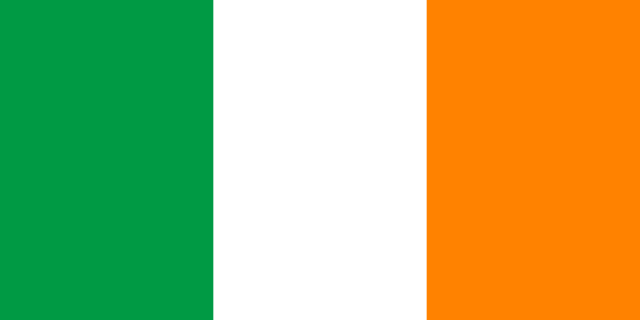
The history of Ireland’s modern flag begins in the mid-nineteenth century. Thomas Francis Meagher introduced the green, white and orange tricolour in Waterford on 7 March 1848. Its arrangement of colours was intended to express reconciliation between the island’s traditions: white stands between green and orange as a symbol of peace.
The tricolour did not replace older flags immediately. Its position strengthened particularly after the Easter Rising of 1916. The Irish Free State used it from 1922, and Article 7 of the 1937 Constitution established the green, white and orange tricolour as the national flag.
Where can the golden harp be seen today?
Although the harp disappeared from the national flag’s design, it did not disappear from Ireland’s official imagery. The state coat of arms remains a golden harp on blue, and the harp is also found on government insignia, seals and coins.
A particularly clear link with the old blue harp flag is the presidential standard of Ireland. It is blue with a golden harp. The harp, however, is not depicted with the same winged female figure: the modern state emblem is based on the medieval harp preserved at Trinity College Dublin.
This instrument is commonly called the Brian Boru harp, even though it dates from the fourteenth century and King Brian Boru died in 1014. The name is traditional, not evidence that he owned the instrument.
Is the blue harp flag the same as Ireland’s presidential standard?
Not quite. Both follow the same basic idea—a golden harp on blue—but the details of the harp and the flags’ functions differ. On historic royal harp banners, the harp may feature a winged woman, while the modern presidential standard uses a different model.
The colours alone are therefore not enough to identify the flag. You also need to consider the harp’s design, the flag’s purpose and the historical period.
Was the blue harp flag Ireland’s national flag?
The blue harp flag is often described as the flag of the Kingdom of Ireland, but the term national flag can be misleading here. In medieval and early modern times, coats of arms represented monarchs, families and realms in ways that do not fully correspond to modern national flags.
A more precise description is a heraldic harp banner associated with the Kingdom of Ireland or a royal banner of arms. Modern computer-drawn reconstructions illustrate the historic emblem; they do not, on their own, prove that a particular ornate design was used continuously from 1542 to 1801.
Frequently asked questions about the Irish harp flag
What does the winged woman on the old Irish flag represent?
The female figure is part of the decorated harp: she forms the instrument’s forepillar. The design is also called a winged-maiden harp. It should not be explained as a definite representation of a particular goddess.
How old is the blue harp flag?
A golden harp on blue appears in Irish heraldic symbolism from around 1270. The harp banner of the Kingdom of Ireland is commonly associated with 1542–1801, but the harp’s individual artistic depictions changed over that period.
Why is there no harp on the modern Irish flag?
The green, white and orange tricolour became a central symbol of the Irish national movement and was confirmed as the national flag in the 1937 Constitution. The harp nonetheless remained Ireland’s official state emblem.
Did the Brian Boru harp really belong to Brian Boru?
Not according to its accepted dating. The historic harp at Trinity College dates from the fourteenth century, while Brian Boru died in 1014. Its name is a traditional designation adopted later.
The story of Ireland’s harp flag in brief
The golden harp shaped into a winged woman on Ireland’s historic blue banner reflects a long development in heraldic imagery. The harp was an Irish emblem in medieval times, the winged female figure entered its design later, and the blue harp banner became associated with the Kingdom of Ireland. Green harp flags subsequently played their own role in national movements. The modern national flag is a tricolour, but the harp survives in the state arms and the presidential standard.
Explore more on Vexilla
- Historic Irish harp flag (1542)
- Historic flags of Ireland
- Modern flag of Ireland
- History of flags
- What do flag symbols mean?
- What is heraldry?
- Test your knowledge of European flags
Sources and further reading
- Crown of Ireland Act 1542 – legal background of the Kingdom of Ireland.
- Irish Department of Enterprise: Protection and Use of State Emblems – medieval roots of the harp, the coat of arms and its present-day use.
- Government of Ireland: The Harp – the state emblem, presidential standard and Trinity College harp.
- Mary Louise O’Donnell: Death of an Icon: Deconstructing the Irish Harp Emblem in the Celtic Tiger Years – peer-reviewed music-historical study of the harp’s visual development.
- Geoff Parsons and Michael Faul: British Royal Banners 1199–Present – presentation on royal banners at an international vexillological congress.
- Government of Ireland: The National Flag – history and current status of the tricolour.
- Scoilnet: The Irish Tricolour Flag and its evolution to National Flag – development of the green harp flag and tricolour.
- Wikimedia Commons: Royal Standard of Ireland (1542–1801) – source and licence for the historic flag illustration; TRAJAN 117 / Sodacan, CC BY-SA 3.0. The historic flag design was used as a reference for the AI-generated cover image.

Aarne Arkisto
Aarne Arkisto explores historical flags, old emblems, the Dannebrog and archival sources.