

Why Does England’s Flag Have a Red Cross?
 Aarne Arkisto Historical emblems writer
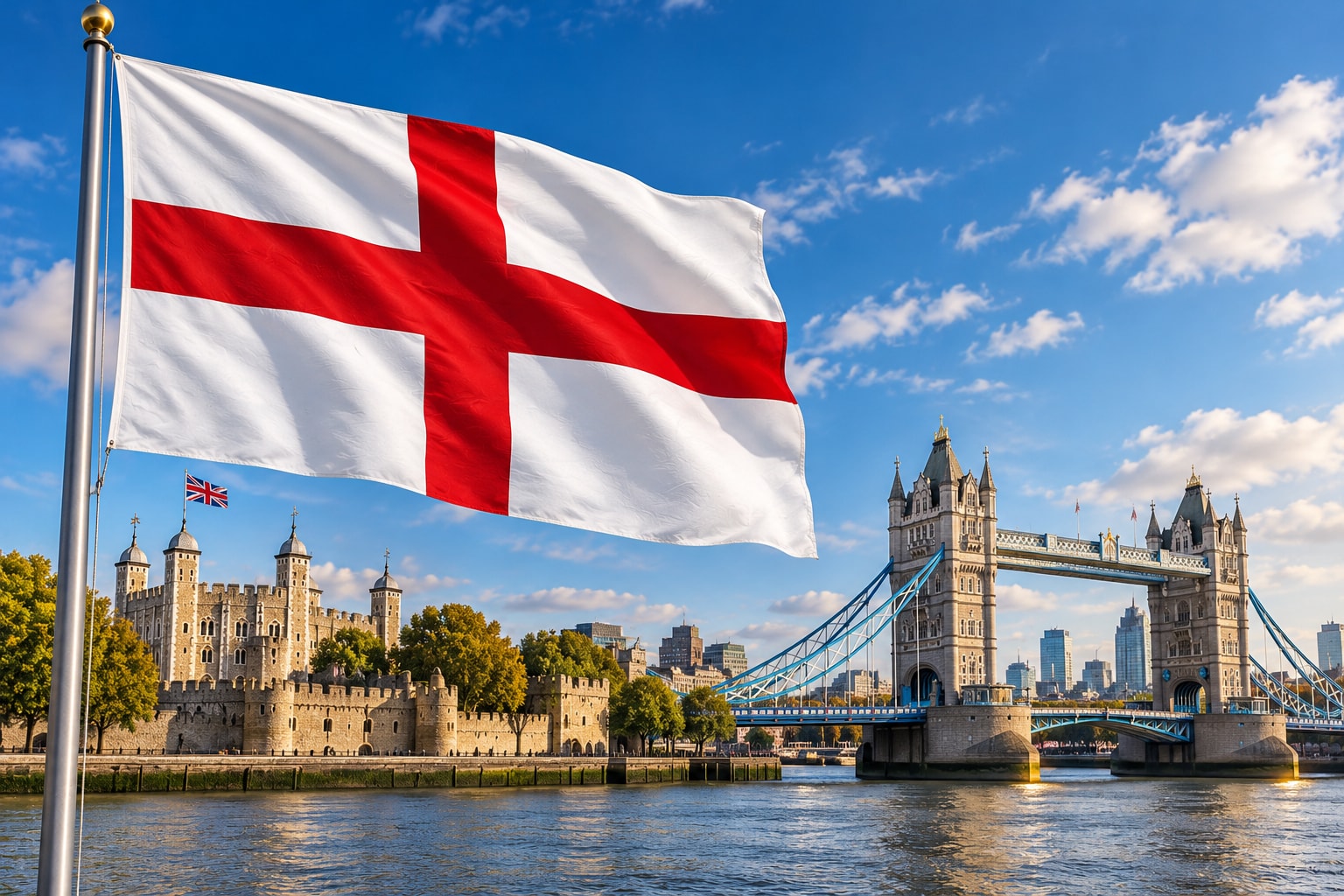
England’s flag has a red cross because it bears St George’s Cross, the emblem associated with England’s patron saint. The design—a red upright cross on a white field—became closely identified with England during the Middle Ages. It also forms one of the central elements of the United Kingdom’s Union Jack.
The flag may be simple, but its history is not. From medieval military banners to modern football terraces, the same two-colour design has taken on different roles over the centuries. See the flag itself on Vexilla’s flag of England page.

What is St George’s Cross?
St George’s Cross is an upright red cross centred on a white field. Its vertical and horizontal arms meet in the middle, distinguishing it from a diagonal cross, or saltire. It is a heraldic emblem associated with St George, a soldier-saint venerated in medieval Christianity. The familiar tale of George slaying a dragon is a legend about the saint, not a historical account of how England adopted its flag.
Nor is the design exclusively English. Genoa, for example, has also long used a red cross on white. Identical-looking flags can therefore have different civic histories and meanings; the design alone does not establish a shared national identity.
When did the red cross become a symbol of England?
There is no single, securely documented day on which England adopted St George’s Cross as its national flag. One important early record comes from 1277, during the reign of Edward I: royal accounts refer to pennons and archers’ arm-guards bearing the arms of St George for English forces. This is evidence of medieval military use, not proof that the modern national flag was formally established in 1277.
Another milestone came in 1348, when Edward III founded the Order of the Garter, placing it under the patronage of St George. The saint and his cross gained a stronger place in English royal and military tradition. Over time, the emblem became the recognisable flag of England—a gradual development rather than the result of one founding decree.
How does England’s cross differ from other cross flags?
On England’s flag, the cross is straight and centred. Scotland’s flag has a white diagonal saltire on blue, with its arms running towards the corners. Nordic flags also use upright crosses, but the intersection is shifted towards the hoist—the side nearest the flagpole.
Explore the differences in Vexilla’s flag-design directories: flags with a centred cross, flags with a saltire and Nordic cross flags. These collections group flags by design; they should not be taken as exhaustive lists of every regional flag using that pattern.
Is England’s flag the same as the Union Jack?
No. England’s flag and the Union Jack represent different things. St George’s Cross is the flag of England, one of the four constituent countries of the UK. The flag of the United Kingdom combines several historic crosses in one design.
When James VI of Scotland also became James I of England in 1603, the two kingdoms came under the same monarch. A first Union Flag followed in 1606, initially for use at sea. It combined England’s red cross of St George with Scotland’s white saltire of St Andrew. The kingdoms themselves did not become one state until 1707.
Following the union with Ireland, a red diagonal cross associated with St Patrick was added in 1801. That produced the basic design of the Union Flag used today. The term Union Jack is also widely used for this national flag.


You can compare national flags containing the Union Jack in Vexilla’s Union Jack design collection. The collection concerns flags that incorporate the emblem; it is not a catalogue of every historic version of the Union Flag.
Why isn’t Wales represented on the Union Jack?
The Welsh flag features a red dragon against white and green. Yet there is no dragon—or separate Welsh symbol—on the Union Jack. By the time the first Union Flag was devised in 1606, Wales had already been incorporated into the Kingdom of England. It was not represented as a separate kingdom in the new combined flag.
That historical explanation does not make the Welsh flag any less distinctive. England, Scotland and Wales each have their own national flag, while the Union Jack represents the United Kingdom as a whole.
Why does England fly its own flag at football matches?
England fields its own national football team in international competitions, even though it is part of the UK. Supporters therefore commonly wave St George’s Cross rather than the Union Jack. Sport is a useful reminder that the flags of the UK and its constituent countries are not interchangeable.
How can you tell these British flags apart?
- England: red upright cross on a white field.
- Scotland: white diagonal saltire on a blue field.
- Wales: red dragon on a white-and-green field.
- United Kingdom: a blue flag combining a red upright cross with red and white diagonal crosses.
The easiest distinction to remember is England: upright red cross; Scotland: diagonal white cross. For more patterns, browse flags with cross designs. You can also try the European flag quiz. Whether constituent-country flags appear in a quiz depends on its settings.
Sources and further reading
- The Flag Institute: England – St George’s Cross — the flag’s status and early recorded use.
- The Flag Institute: The many crosses of St George — other places that use the emblem.
- The Flag Institute: History of the Union Flag — the 1606 and 1801 designs.
- UK Parliament: written question HL7725 — official explanation of the Union Flag’s origins.
- The Royal Family: Union Jack — the constituent crosses and Wales’s absence from the design.
Aarne Arkisto
Aarne Arkisto explores historical flags, old emblems, the Dannebrog and archival sources.