

Lebanon’s symbol: why is the cedar tree the country’s emblem?
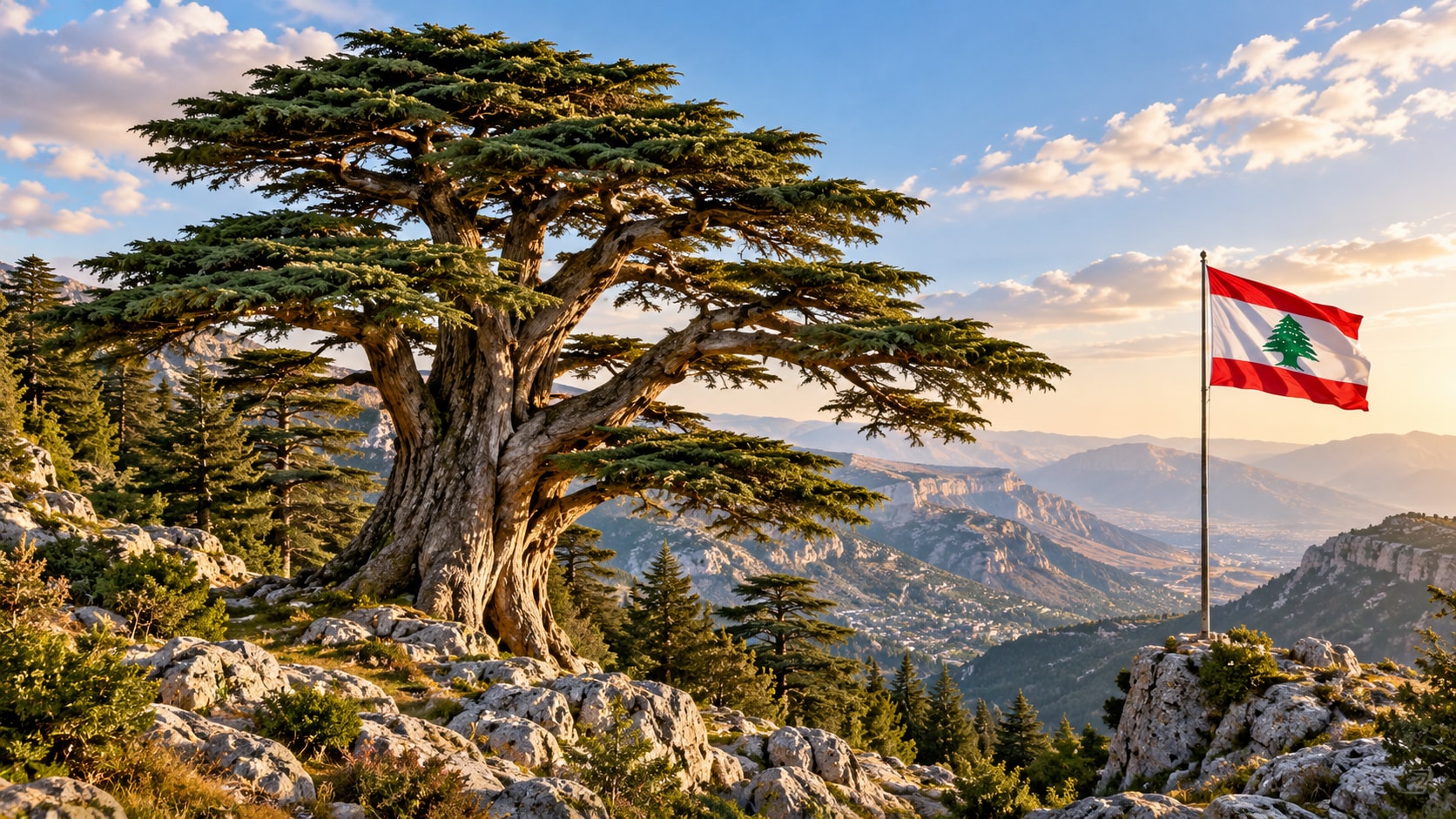
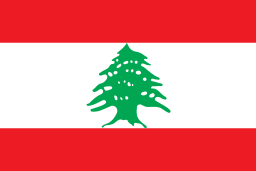
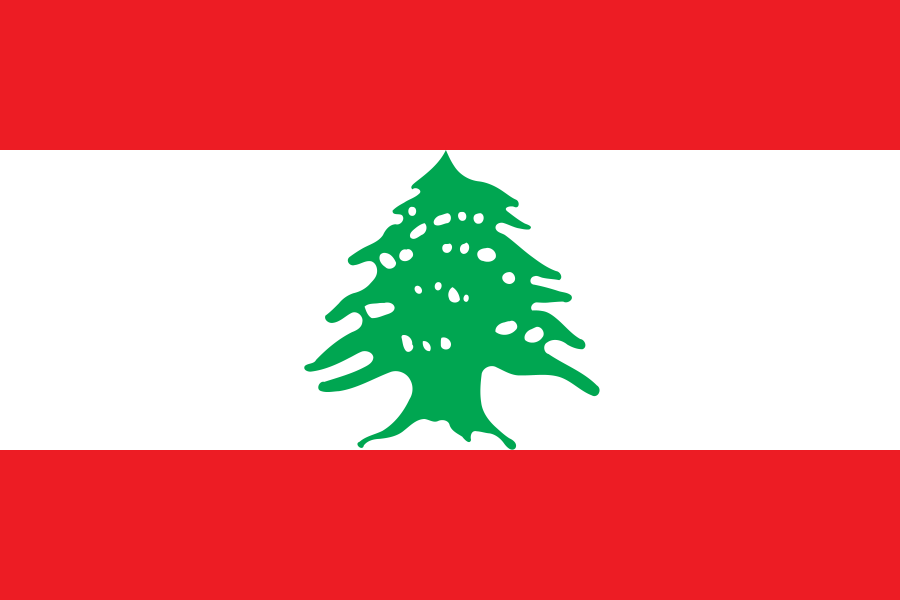
Lebanon’s best-known national symbol is the cedar of Lebanon (Cedrus libani). The green cedar appears in the centre of the Lebanese flag on the wide white band, and it is one of the most recognisable plant symbols used on a national flag.
The cedar is not merely a decorative element. It connects the modern Lebanese state with the mountains of Lebanon, the region’s ancient cedar forests, and a long historical tradition. The present form of the flag was adopted around independence in 1943, but the association between the cedar and Lebanon is much older.
To see the current flag and its main features, visit Vexilla’s Lebanon flag page. This article focuses on a different question: why did the cedar become the symbol of Lebanon?
What is the symbol of Lebanon?
The clearest answer to the question “what is the symbol of Lebanon?” is the cedar of Lebanon. Its scientific name is Cedrus libani, and this is the tree represented on the national flag.
The cedar is an especially powerful symbol because it refers both to nature and to national identity. It is not simply an abstract image: the cedar of Lebanon is a real tree species associated with the mountainous landscapes of Lebanon and the surrounding region.
It is important, however, to distinguish between the official definition of the flag and later symbolic interpretations. The Lebanese Constitution requires a green cedar on the flag, but it does not provide a single exhaustive official definition of what the tree must “mean”.
What is the cedar of Lebanon?
The cedar of Lebanon, Cedrus libani, is a conifer in the pine family. Royal Botanic Gardens, Kew recognises the species under the name Cedrus libani in Plants of the World Online and places its native range from southern Turkey to Lebanon.
That point is worth clarifying: the cedar of Lebanon does not grow naturally only in Lebanon. Its name and symbolic importance are nevertheless especially closely linked with Lebanon and the cedar forests of the Lebanese mountains.
Kew also lists the species as Vulnerable in the IUCN assessment cited by its database. Lebanon’s national symbol is therefore also a living part of the region’s natural heritage.
Why did the cedar become the symbol of Lebanon?
The cedar’s importance is rooted above all in its long association with the mountains of Lebanon and the history of the eastern Mediterranean. Cedars from this region were already known in antiquity, particularly for their highly valued timber.
UNESCO describes the Forest of the Cedars of God as a remnant of the great cedar forests that once covered parts of the Lebanese mountains. Cedar wood was highly prized in the ancient world.
The cedar also appears in ancient Near Eastern texts and in biblical tradition. This does not mean that the modern Lebanese state has used exactly the same national symbol continuously for thousands of years. The important point is the continuity between a place, a tree species, and a cultural memory.
When modern Lebanon needed a distinctive national emblem, the cedar was therefore a natural choice: it was already deeply associated with the country and its mountains.
The cedar appeared on Lebanese flags before 1943
The history of the current flag should not be confused with the history of the cedar symbol itself. In the historical flag material used by Vexilla, the cedar already appears on a flag dated 1918. On the 1920 flag, the cedar is placed in the centre of the French tricolour. In 1943, it appears within a red-white-red composition close to the present national flag.
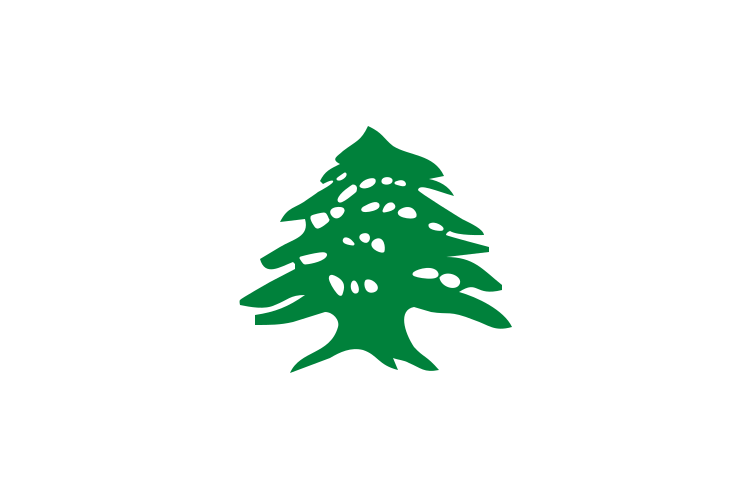 1918
1918
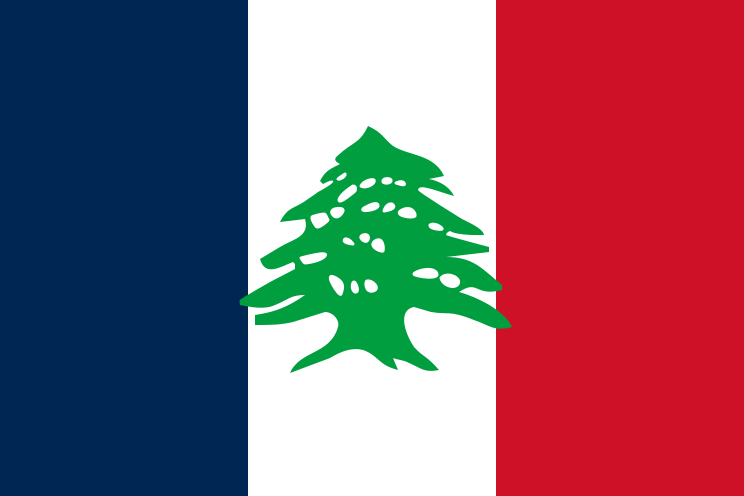 1920
1920
 1943
1943
This continuity matters: the graphic setting changed, but the cedar remained the distinctive element. The move from the French tricolour to a specifically Lebanese flag also reflects the political transformation that accompanied independence.
How did the current Lebanese flag emerge in 1943?
The present flag is directly connected with Lebanese independence in 1943. A publication by the Lebanese Armed Forces on the history of the flag states that in November 1943 Lebanese members of parliament designed a new red-white-red flag with the cedar at its centre.
The historical account also preserves a famous detail: an early sketch of the new flag was reportedly drawn on a school notebook page. The importance of this story is not merely anecdotal. It shows how closely the flag’s creation was tied to the immediate political context of independence.
The new definition of the flag was then written into Article 5 of the Lebanese Constitution through the amendment of 7 December 1943.
What does the Lebanese Constitution say about the cedar on the flag?
Article 5 of the Constitution is an essential source because it defines not only the colours of the flag but also the position of the cedar.
- The flag has three horizontal bands: red, white and red.
- The central white band is equal in height to the two red bands combined.
- A green cedar tree is placed in the centre of the white band.
- The top of the cedar reaches the upper red band and its base reaches the lower red band.
- The text also sets the cedar’s general proportions within the white band.
The cedar is therefore not an optional decorative motif. It forms part of the constitutional definition of Lebanon’s national flag.
The Constitution does not, however, provide an extremely detailed drawing of every branch. For that reason, the precise graphic form of the cedar can vary slightly between representations while still preserving the flag’s essential features.
What does the cedar of Lebanon symbolise?
The most accurate answer separates officially defined elements from broader cultural interpretations. The Constitution requires a green cedar, but it does not state that the tree has only one fixed legal meaning.
Above all, the cedar represents Lebanon, its mountains, and the continuity of its historical heritage. UNESCO emphasises the importance of the cedar in the relationship between the Lebanese people and their land, which helps explain why the tree became such a powerful national emblem.
The cedar is also commonly associated with longevity, endurance, and strength. These ideas are best treated as symbolic interpretations rather than as an official constitutional definition.
What do the red and white colours of the Lebanese flag mean?
Several traditional interpretations are associated with the colours of the flag. Red is often linked with sacrifices made for independence and freedom, while white is associated with peace, purity, and Lebanon’s snow-covered mountains.
These interpretations should not be presented as if they were fixed legal definitions. Article 5 defines the colours and their arrangement, but it does not assign them a single official symbolic meaning in the form of a constitutional “colour dictionary”.
Does the cedar on the flag represent a specific species?
Yes. The symbol refers to the cedar of Lebanon, Cedrus libani. It is not simply a generic evergreen tree. The cedar’s silhouette therefore contributes directly to the visual identity of the flag.
Mature cedars of Lebanon can develop broad, layered, almost horizontal crowns. On the flag, that natural form is simplified into a clear graphic symbol that remains recognisable even at a small size.
The Cedars of God: a national symbol that also exists in the landscape
The Lebanese cedar is not found only on flags. In northern Lebanon, the Forest of the Cedars of God, or Horsh Arz el-Rab, forms part of the UNESCO World Heritage property “Ouadi Qadisha and the Forest of the Cedars of God”.
The site was inscribed on the World Heritage List in 1998. UNESCO describes the forest as a surviving remnant of the extensive cedar forests of Lebanon, whose timber was highly valued in antiquity.
This is what makes Lebanon’s symbol particularly interesting: the same cedar is at once a graphic emblem, a living tree species, and a real part of the country’s natural and cultural heritage.
Why is the Lebanese flag so easy to recognise?
Many national flags rely mainly on stripes, crosses, stars, or simple geometric shapes. A large tree in the centre of a national flag is much less common.
The Lebanese flag is easy to recognise from three features:
- a horizontal red-white-red layout;
- a wide central white band;
- a large green cedar tree in the centre.
The combination is distinctive enough that the cedar is often the first detail noticed, even when the flag is displayed at a small size.
To compare Lebanon with other countries on the continent, explore flags of Asia.
How can you recognise Lebanon in a flag quiz?
Lebanon is relatively easy to identify in a flag quiz if you remember the cedar.
- A green tree in the centre should immediately suggest Lebanon.
- The background is arranged in horizontal red-white-red bands.
- The central white band is clearly wider than either red band.
- The symbol is a cedar tree, not a leaf, palm tree, or coat of arms.
You can practise with the Asia flag quiz or the all countries flag quiz.
Frequently asked questions about Lebanon’s symbol
What is the national symbol of Lebanon?
Lebanon’s best-known national symbol is the cedar of Lebanon (Cedrus libani). A green cedar also appears in the centre of the national flag.
What tree is on the Lebanese flag?
The flag shows a cedar of Lebanon, Cedrus libani. The tree has long been associated with the mountains and history of the country.
Why is there a cedar tree on the flag of Lebanon?
The cedar connects the flag with Lebanon’s nature, mountains, and long historical tradition. It was already used as a symbol before the adoption of the present red-white-red flag in 1943.
Does the cedar of Lebanon grow only in Lebanon?
No. According to Kew’s Plants of the World Online, the native range of Cedrus libani extends from southern Turkey to Lebanon. The species nevertheless has an especially strong historical and national association with Lebanon.
When was the current Lebanese flag adopted?
The red-white-red flag with a green cedar was adopted in the context of independence in 1943. Its definition was written into Article 5 of the Constitution on 7 December 1943.
Is the exact shape of the cedar fixed by law?
The Constitution defines the cedar’s colour, position, and essential proportions, but it does not provide one uniquely detailed drawing of every branch. Small graphic variations are therefore possible.
Lebanon’s symbol in brief
The symbol of Lebanon is the cedar of Lebanon. Its strength as a national emblem comes from the way it connects the flag to a real landscape and a very old regional tradition. Cedars in the Lebanese mountains were known in antiquity, and the tree was already used as an emblem before the current national flag.
In 1943, the cedar was placed at the centre of the new red-white-red flag of independence. Today, Article 5 of the Lebanese Constitution still defines the green cedar as an essential element of the national flag.