

Flag of Barbados
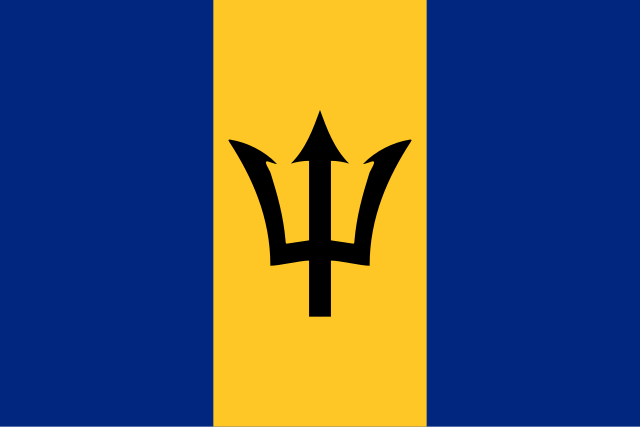
Three equal-width vertical bands.
Current flag

Flag emoji 🇧🇧
Barbados
Flag facts
Flag design
Three equal-width vertical bands.
- Layout
- Vertical bands
- Number of bands
- 3
- Details
- Equal-width bands
- Colours
- Blue, yellow, and black
The broken trident on Barbados’s flag
Barbados’s flag has vertical ultramarine, gold and ultramarine bands with a black broken trident at the centre. The missing shaft is deliberate: the emblem is not an ordinary three-pronged trident with its handle hidden.
The broken shaft represents the end of colonial rule and the country’s move to independence in 1966. The blue bands are commonly linked with sea and sky, and gold with the beaches. Grantley W. Prescod’s design was adopted on Independence Day, 30 November 1966.
Sources
Country facts
- Type
- Country
- Name
- Barbados
- Continent
- North and Central America
- Capital
- Bridgetown
- ISO 3166-1 alpha-2
- BB
- ISO 3166-1 alpha-3
- BRB
- ISO 3166-1 numeric
- 052
- Top-level domain
- .bb
- Area
- 431 km²
- Population
- 282,623 (2025)
- Currency
- BBD
- Calling code
- ++1-246
Flags with a similar layout
These flags come from the same region and share one or more design characteristics.


Historical flags: Barbados (1632–)
Images are ordered by the years listed in the collection. A listed year may not be the flag’s official adoption year.
About historical flags
Vexilla's historical flag collection includes former flags associated with present-day countries and territories, as well as flags of states, empires, and other authorities that historically governed them.
A flag's inclusion in a country's historical collection does not necessarily mean that the country was independent at the time or that the flag was its own national flag.
The years shown are based on historical records in the dataset and do not always indicate the date of official adoption. The collection is not exhaustive, and historical usage, territorial coverage, and interpretations may vary.