Why are there an eagle, a snake and a cactus on Mexico's flag?
They recall the traditional sign that showed the Mexica where to found Tenochtitlan, now Mexico City.


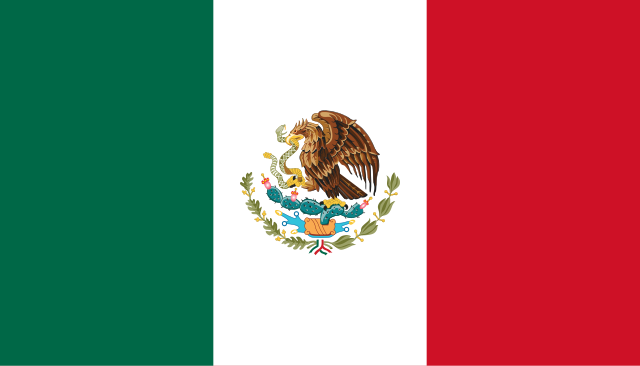
Mexico’s flag has three equal vertical bands in green, white and red. The national coat of arms sits at the centre of the white band; law also specifies the flag’s proportions and emblem.

Mexico
Information about the flag’s design, colours and proportions.
The flag has 3 vertical bands from hoist to fly: green · white · red.
Mexico's flag is a vertical green, white and red tricolour. In the centre of the white band is the national coat of arms: an eagle standing on a nopal cactus and holding a snake.
The emblem recalls the Mexica foundation story of Tenochtitlan. The colours date from the independence era, although their interpretations have changed over time. The present coat-of-arms design was adopted in 1968 and distinguishes the flag from Italy's plain tricolour.
Mexico’s National Shield shows a Mexican eagle in profile, with its left talon on a flowering nopal growing from a rock in a lake. The eagle holds a curved snake with its right talon and beak; oak and laurel branches frame the lower part of the emblem.
The shield brings together a longstanding image associated with the Mexica account of Tenochtitlan’s founding. Mexico’s Foreign Ministry traces the eagle on a cactus to that story. The law defines the shield’s appearance, while the historical account explains the image’s cultural context.
The National Flag Act specifies three equal vertical bands, ordered green, white and red from the flagstaff. The National Shield is centred in the white band, and its diameter is three quarters of that band’s width.
The same article sets the flag’s width-to-length proportion at 4:7. These measurements distinguish the official design from a generic tricolour and make the centred emblem a defining feature. The law describes the flag’s form without assigning fixed meanings to each colour.
Mexico’s green, white and red tricolour emerged during the independence period. The Foreign Ministry’s historical account records vertical bands and an eagle on a cactus on the First Empire flag in 1822. Later versions changed the eagle and other details.
A 1916 decree established an eagle shown in profile. Mexico’s present flag form was set out in the national-symbols law of 1968, and the current law regulates its design and use. The law also designates 24 February as National Flag Day.
They recall the traditional sign that showed the Mexica where to found Tenochtitlan, now Mexico City.
The present design was adopted in 1968.
From the flagstaff, the three equal vertical bands are green, white and red.
The law sets a width-to-length proportion of 4:7.
It depicts an eagle holding a snake, perched on a nopal cactus that grows from a rock in a lake, with oak and laurel branches below.
It is observed on 24 February, the date designated in the National Flag Act.
These flags come from the same region and share one or more design characteristics.
Images are ordered by the years listed in the collection. A listed year may not be the flag’s official adoption year.
Vexilla's historical flag collection includes former flags associated with present-day countries and territories, as well as flags of states, empires, and other authorities that historically governed them.
A flag's inclusion in a country's historical collection does not necessarily mean that the country was independent at the time or that the flag was its own national flag.
The years shown are based on historical records in the dataset and do not always indicate the date of official adoption. The collection is not exhaustive, and historical usage, territorial coverage, and interpretations may vary.


