How is the official blue specified?
The amendment gives Pantone 286 C and RGB 0, 51, 160.


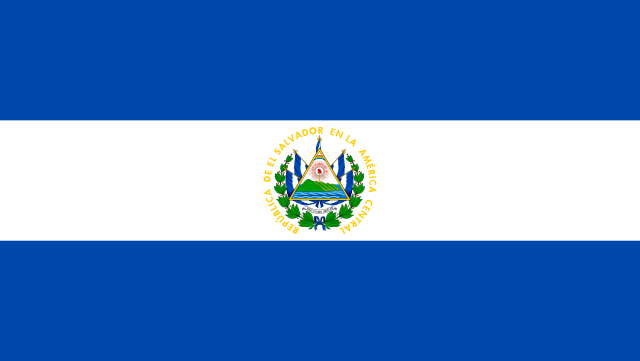
El Salvador’s flag is a blue-white-blue triband, but the law prescribes several official forms whose central details depend on how the flag is used.

El Salvador
The flag has 3 horizontal bands from top to bottom: blue · white · blue.
El Salvador’s flag has three equal blue-white-blue bands. The law describes official versions for buildings and ceremonies that can add the coat of arms or the motto “God, Union, Liberty,” so a plain triband is not the only prescribed form.
Article 5 of El Salvador’s Law of Patriotic Symbols describes the national flag as three equal horizontal bands: blue, white and blue. The order is the same in each official form, so the basic design remains recognisable even when an emblem or wording appears in the middle.
The law specifies the official blue as Pantone 286 C and gives its corresponding RGB value as 0, 51, 160. These technical values settle the colour standard; the statute does not assign a separate symbolic meaning to the blue and white bands themselves.
The law distinguishes three official forms: the magna flag, the flag used at public offices and buildings, and the parade flag. The magna version carries the national coat of arms in the white band. The other prescribed forms use the national motto, “God, Union, Liberty”; the parade version also has its ceremonial ribbons.
This means that photographs of El Salvador’s flag may show different centres without depicting different national designs. A blue-white-blue flag without a central device is also used, while the law’s named forms set out when the coat of arms, motto and ceremonial details belong on the cloth.
The national coat of arms places five volcanoes above a landscape between two seas, with a rainbow and a liberty cap among its elements. The design also includes the date 15 September 1821, the country’s name, and the motto “God, Union, Liberty”. These are parts of the emblem specified by law, rather than explanations inferred from the flag’s colours.
The Law of Patriotic Symbols, enacted as Legislative Decree No. 115 in 1972, sets out the flag’s forms and rules for their display. Its historical recitals connect the national symbols with the former Central American federation and refer to an earlier decree of 17 May 1912 concerning the flag and coat of arms.
The amendment gives Pantone 286 C and RGB 0, 51, 160.
The three equal horizontal bands are blue, white and blue, from top to bottom.
The law defines several official forms. The magna flag bears the coat of arms, while other forms carry the motto “God, Union, Liberty”; the parade version also has ribbons.
Among its legally specified elements are five volcanoes, a rainbow, a liberty cap, the date 15 September 1821, the country’s name and the motto “God, Union, Liberty”.
The Law of Patriotic Symbols was enacted as Legislative Decree No. 115 in 1972. Its recitals also refer to an earlier decree dated 17 May 1912.
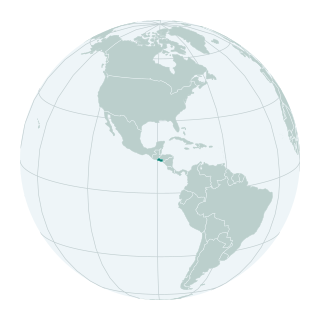
These flags come from the same region and share one or more design characteristics.
Images are ordered by the years listed in the collection. A listed year may not be the flag’s official adoption year.
Vexilla's historical flag collection includes former flags associated with present-day countries and territories, as well as flags of states, empires, and other authorities that historically governed them.
A flag's inclusion in a country's historical collection does not necessarily mean that the country was independent at the time or that the flag was its own national flag.
The years shown are based on historical records in the dataset and do not always indicate the date of official adoption. The collection is not exhaustive, and historical usage, territorial coverage, and interpretations may vary.


