What does the flag of Equatorial Guinea look like?
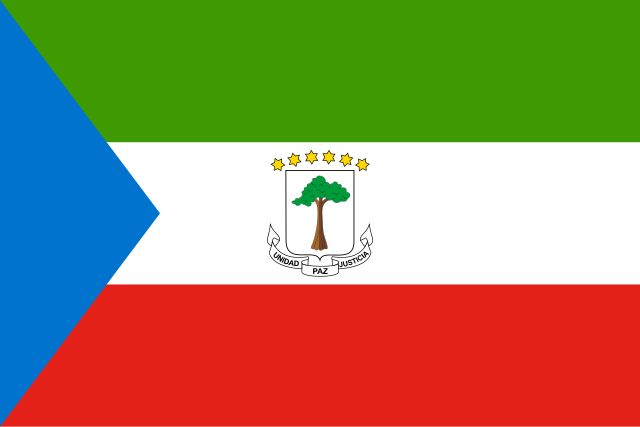
It has equal green, white and red horizontal stripes, a blue triangle at the hoist and the national coat of arms centred on the white stripe.


Equatorial Guinea’s flag combines three equal horizontal bands with a blue triangle at the hoist and the national coat of arms on the white band. The Fundamental Law sets out that design, while the national statistics yearbook explains the colors and emblem.

Equatorial Guinea
The flag has 3 horizontal bands from top to bottom: green · white · red.
Article 4 of the Fundamental Law describes three horizontal stripes of equal dimensions: green above, white in the middle and red below. A blue triangle sits at the end nearest the flagpole, and the Republic’s coat of arms is placed at the centre of the flag.
The legal description identifies both the order of the colors and the placement of the main elements. The blue triangle points into the striped field, while the coat of arms occupies the white stripe; together these details distinguish the national flag from a plain green, white and red tricolour.
INEGE’s 2022 statistical yearbook associates green with the country’s forest wealth, blue with the sea connecting the mainland and islands, white with peace, and red with blood shed in the struggle for independence. These are the meanings given in the country’s official yearbook.
The same account describes six yellow six-pointed stars above a shield bearing a ceiba tree, with a scroll below carrying the motto “Unity, Peace and Justice.” The tree and stars belong to the coat of arms, rather than being separate additions to the flag’s stripes.
Equatorial Guinea became independent on 12 October 1968. Article 4 of the Fundamental Law connects the national anthem with the proclamation of independence on that date, placing the flag among the Republic’s defining national symbols.
The same article names the flag, coat of arms, motto and anthem in turn. It states that the coat of arms is established by law and gives the motto as “Unity, Peace and Justice,” providing a legal context for the emblem shown at the centre of the flag.
It has equal green, white and red horizontal stripes, a blue triangle at the hoist and the national coat of arms centred on the white stripe.
INEGE’s 2022 yearbook links green to forest wealth, blue to the sea between mainland and islands, white to peace, and red to the independence struggle.
It includes six yellow stars, a shield with a ceiba tree and a scroll bearing the motto “Unity, Peace and Justice,” as described by INEGE.
Equatorial Guinea became independent on 12 October 1968; the Fundamental Law links the national anthem to the proclamation that day.
These flags come from the same region and share one or more design characteristics.
Images are ordered by the years listed in the collection. A listed year may not be the flag’s official adoption year.
Vexilla's historical flag collection includes former flags associated with present-day countries and territories, as well as flags of states, empires, and other authorities that historically governed them.
A flag's inclusion in a country's historical collection does not necessarily mean that the country was independent at the time or that the flag was its own national flag.
The years shown are based on historical records in the dataset and do not always indicate the date of official adoption. The collection is not exhaustive, and historical usage, territorial coverage, and interpretations may vary.


