Why is the middle band of Gabon's flag yellow?
Yellow refers to the sun and to the equator crossing the country.


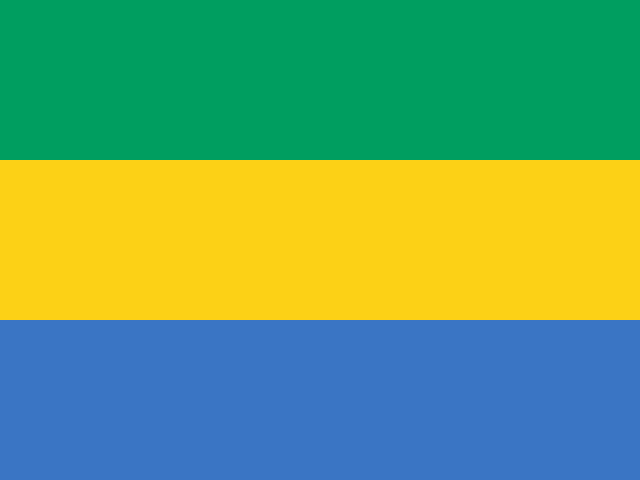
Gabon’s flag is a horizontal green, yellow and blue tricolour. Its present form was defined by a 1960 law, shortly before independence.

Gabon
Three equal-width horizontal bands.
Gabon uses green for forests, yellow for the sun and equator, and blue for the Atlantic in a plain horizontal tricolour.
Article 2 of Gabon’s 2024 Constitution defines the national emblem as a tricolour of three equal horizontal bands: green at the top, yellow in the middle and blue below. The legal description fixes both the order and the equal size of the bands.
The current design has no coat of arms, star or lettering laid over those bands. Its simple layout makes the sequence itself decisive: green, yellow, then blue from the hoist edge to the fly and from top to bottom alike.
Gabon’s Ministry of Foreign Affairs links green with the equatorial forest, fertility and agricultural wealth. It describes yellow as the equator crossing the country, the sun, mineral resources and hospitality; these are the ministry’s explanations, not wording in the Constitution.
The ministry associates blue with the sea along Gabon’s coast, its rivers and sky, as well as peace. Read together, the colours connect the flag to the country’s forests, equatorial position and Atlantic coastline rather than to separate heraldic emblems.
An earlier flag used during the period of autonomy had green and blue horizontal bands, a narrower yellow band between them and the French tricolour in the canton, according to Gabon’s Ministry of Labour. The later design removed the canton and made all three bands equal.
Law No. 54/60 changed the national emblem on 9 August 1960, eight days before independence was proclaimed on 17 August. A 2009 decree established 9 August as National Flag Day, commemorating the change rather than the independence date.
Yellow refers to the sun and to the equator crossing the country.
From top to bottom, the equal horizontal bands are green, yellow and blue.
The Foreign Ministry connects green with forests and fertility, yellow with the equator, sun, mineral wealth and hospitality, and blue with the sea, rivers, sky and peace.
The earlier design had a French tricolour in the canton and a narrower yellow stripe between green and blue bands. The 1960 change removed the canton and made the three bands equal.
It commemorates the 9 August 1960 law that changed the national emblem. Gabon proclaimed independence on 17 August 1960.
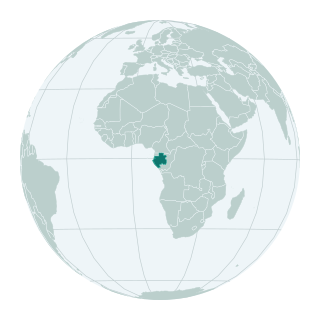
These flags come from the same region and share one or more design characteristics.
Images are ordered by the years listed in the collection. A listed year may not be the flag’s official adoption year.
Vexilla's historical flag collection includes former flags associated with present-day countries and territories, as well as flags of states, empires, and other authorities that historically governed them.
A flag's inclusion in a country's historical collection does not necessarily mean that the country was independent at the time or that the flag was its own national flag.
The years shown are based on historical records in the dataset and do not always indicate the date of official adoption. The collection is not exhaustive, and historical usage, territorial coverage, and interpretations may vary.


