What does the eagle on Kazakhstan's flag convey?
The soaring steppe eagle is associated with freedom beneath the golden sun.


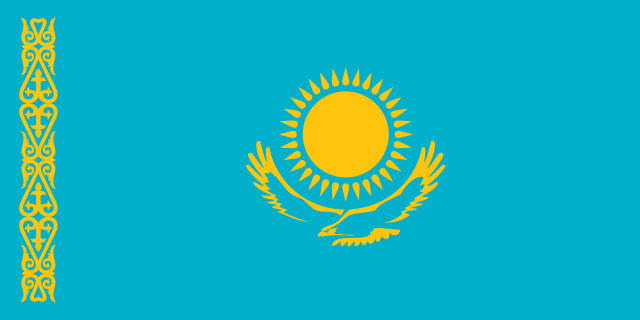
Kazakhstan's sky-blue flag shows a golden sun above a steppe eagle, with a national ornament beside the hoist. The state adopted the design in 1992; official explanations of its symbols are distinct from its legal specifications.

Kazakhstan
Information about the flag’s design, colours and proportions.
Kazakhstan's sky-blue field carries a golden sun, soaring steppe eagle and national ornamental pattern representing life, freedom and cultural heritage.
The flag's proportions are 2:1. A golden sun with 32 rays appears above a soaring steppe eagle on a sky-blue field, while a vertical national ornament runs along the hoist. The law specifies the arrangement and proportions.
The ornament is a separate design element beside the central figures. Kazakhstan's official guidance connects it with the country's artistic and cultural traditions.
Kazakhstan adopted its national flag on 4 June 1992, after becoming independent. The design is by artist Shaken Niyazbekov.
The constitutional law on state symbols sets out the official design. The Ministry of Foreign Affairs publishes explanations of the colours and motifs; those interpretations should be distinguished from the law's technical description.
Kazakhstan's Ministry of Foreign Affairs says blue represents a clear sky, peace and prosperity, and the uninterrupted field expresses unity. These are official explanations of the symbolism, not measurements in the flag law.
The Ministry interprets the sun's rays as grain associated with abundance and the soaring eagle as sovereignty and aspiration toward the future. It connects the staff-side ornament with Kazakh artistic traditions.
The soaring steppe eagle is associated with freedom beneath the golden sun.
A golden sun with 32 rays and a soaring steppe eagle appear on a sky-blue field; a vertical national ornament is beside the hoist.
The flag was adopted on 4 June 1992. Its designer was artist Shaken Niyazbekov.
Kazakhstan's Ministry of Foreign Affairs describes it as referring to Kazakh artistic and cultural traditions.
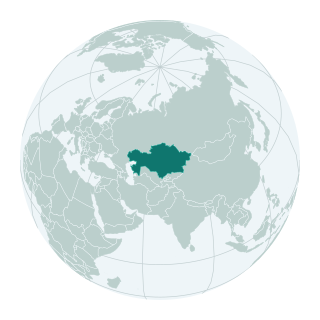
These flags come from the same region and share one or more design characteristics.
Images are ordered by the years listed in the collection. A listed year may not be the flag’s official adoption year.
Vexilla's historical flag collection includes former flags associated with present-day countries and territories, as well as flags of states, empires, and other authorities that historically governed them.
A flag's inclusion in a country's historical collection does not necessarily mean that the country was independent at the time or that the flag was its own national flag.
The years shown are based on historical records in the dataset and do not always indicate the date of official adoption. The collection is not exhaustive, and historical usage, territorial coverage, and interpretations may vary.


