Where is the red star placed on North Korea's flag?
It sits inside a white disc near the hoist on the broad red band.


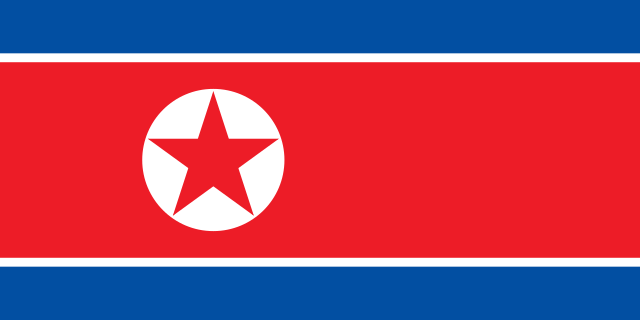
North Korea’s flag combines a broad red centre panel with blue and white stripes and a red star inside a white disc near the hoist.

North Korea
The flag has 5 horizontal bands from top to bottom: blue · white · red · white · blue.
North Korea's broad red band is framed by white and blue, with a red revolutionary star inside a white disc near the hoist.
Article 166 describes a broad red panel through the centre, bordered by a narrow white stripe and a broad blue stripe above and below. A five-pointed red star sits inside a white circle near the hoist, so the emblem is deliberately off-centre.
Article 166 sets the flag’s height-to-width ratio at 1:1.65. From top to bottom, the bands are blue, white, red, white and blue; the red centre is wider than the white separators, while the blue outer bands are broad.
North Korea continued to use the Taegeukgi after Japan’s colonial rule ended in 1945. KBS reports that the new flag was announced on 24 July 1948 and formally adopted on 8 September, the day the first DPRK Constitution was adopted.
The 1948 Constitution’s Article 102 already described the red centre, the star in a white circle and the surrounding bands. The current Constitution, adopted in 2026, keeps that basic design in Article 166 and sets a different height-to-width ratio.
A 1948 account reproduced with the Library of Congress translation described the red star as a guide toward the people’s goals. It associated red with popular resolve, blue with a peace-loving life and white with freedom and hope; these are period interpretations, not measurements of the design.
The constitutional article specifies the flag’s appearance and proportions but assigns no meanings to its colours or star. Keeping that distinction clear separates the legal description from explanations published by writers and commentators.
It sits inside a white disc near the hoist on the broad red band.
Article 166 sets the flag’s height-to-width ratio at 1:1.65.
The red five-pointed star sits inside a white circle near the hoist, on the broad central red panel.
It was formally adopted on 8 September 1948, when the first DPRK Constitution was adopted.
No. It defines the design and proportions. Symbolic explanations come from separate historical accounts and commentators.
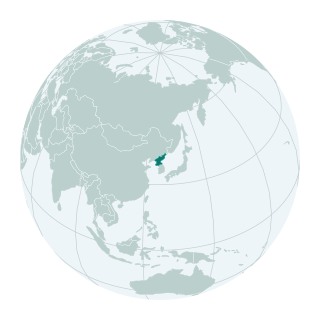
These flags come from the same region and share one or more design characteristics.
Images are ordered by the years listed in the collection. A listed year may not be the flag’s official adoption year.
Vexilla's historical flag collection includes former flags associated with present-day countries and territories, as well as flags of states, empires, and other authorities that historically governed them.
A flag's inclusion in a country's historical collection does not necessarily mean that the country was independent at the time or that the flag was its own national flag.
The years shown are based on historical records in the dataset and do not always indicate the date of official adoption. The collection is not exhaustive, and historical usage, territorial coverage, and interpretations may vary.


