Where was the Irish tricolour first flown?
Thomas Francis Meagher first flew it at 33 The Mall in Waterford on 7 March 1848, according to the Department of the Taoiseach.

Ireland’s green, white and orange tricolour has a place in the Constitution. Official guidance sets out its proportions and traces its journey from Waterford in 1848 to national status.
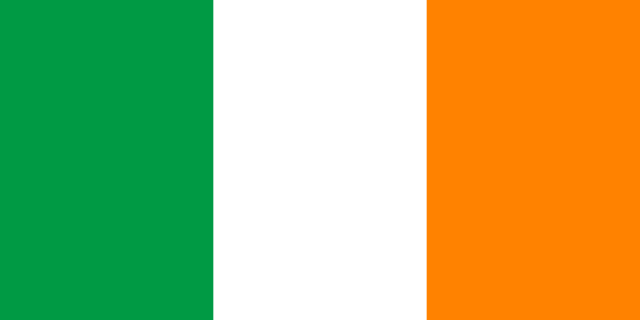

Ireland
Information about the flag’s design, colours and proportions.
Three equal-width vertical bands.
Ireland’s flag has equal vertical bands of green, white and orange, with green at the hoist. The official explanation describes the white as a lasting truce and a union of people from different traditions on the island.
Green is commonly associated with the Irish nationalist tradition and orange with the Protestant community linked historically with William of Orange. These associations explain the design’s intended bridge between traditions; they do not mean that every person in either community is represented by a single colour.
Article 7 of the Constitution identifies Ireland’s national flag as the tricolour of green, white and orange. It gives the colours in their official order, while the government’s flag guidance provides the practical description of the design.
The Department of the Taoiseach says the flag is intended to express inclusion and the aspiration for unity between people of different traditions on the island. That is the government’s stated interpretation of the flag’s message.
The official guidance describes a flag twice as wide as it is high, divided into three vertical bands of equal size. The green band belongs next to the flagstaff, followed by white and then orange.
This order matters when the flag is raised: the green stripe is at the hoist, not the orange one. The official description specifies the layout and proportions without prescribing a particular shade for each colour.
Thomas Francis Meagher first flew the tricolour at 33 The Mall in Waterford on 7 March 1848. It was later flown over Dublin’s General Post Office during the 1916 Rising.
The Irish Free State adopted it as its flag in 1922. Article 7 of the 1937 Constitution then formally confirmed the green, white and orange tricolour as Ireland’s national flag.
Thomas Francis Meagher first flew it at 33 The Mall in Waterford on 7 March 1848, according to the Department of the Taoiseach.
The official guidance says the flag is twice as wide as it is high, with three vertical bands of equal size.
It was adopted as the flag of the Irish Free State in 1922 and formally confirmed as the national flag in the 1937 Constitution.
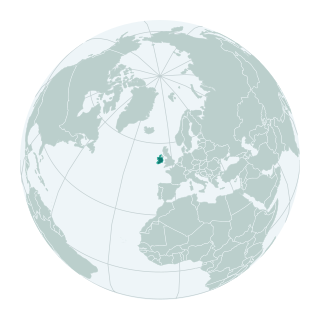
These flags come from the same region and share one or more design characteristics.
Images are ordered by the years listed in the collection. A listed year may not be the flag’s official adoption year.
Vexilla's historical flag collection includes former flags associated with present-day countries and territories, as well as flags of states, empires, and other authorities that historically governed them.
A flag's inclusion in a country's historical collection does not necessarily mean that the country was independent at the time or that the flag was its own national flag.
The years shown are based on historical records in the dataset and do not always indicate the date of official adoption. The collection is not exhaustive, and historical usage, territorial coverage, and interpretations may vary.
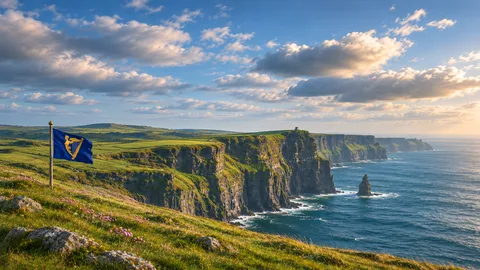
 Aarne Arkisto Historical emblems writer
Ireland’s blue harp flag features a golden harp with a winged female figure. Where did the unusual design come from, why were some harp flags green, and what became of the harp?
 Aarne Arkisto Historical emblems writer
England’s red cross is St George’s Cross. Discover how the design became an English emblem, why it appears in the Union Jack and how it differs from Scotland’s flag.


