


The Nordic cross
Seven flags carry a cross extending to the edges, with its upright nearer the hoist. The shared layout reflects a long regional flag tradition.

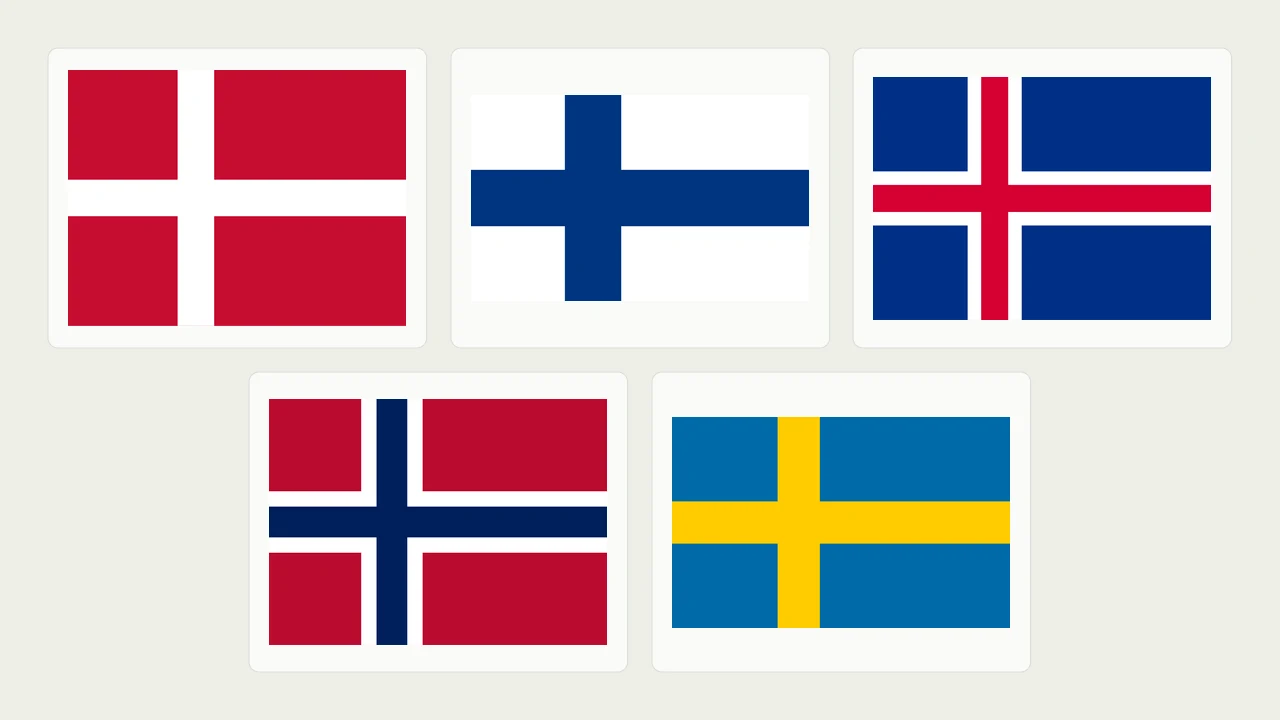
The five independent Nordic countries are Denmark, Finland, Iceland, Norway and Sweden. Their flags share an off-centre Nordic cross. Explore these five national flags alongside the flags of Åland, the Faroe Islands and Greenland.
8 / 8
Seven flags carry a cross extending to the edges, with its upright nearer the hoist. The shared layout reflects a long regional flag tradition.
Denmark’s red-and-white Dannebrog has a long history. The tale that it fell from the sky in 1219 is a legend, not a documented origin.
Both flags use the same off-centre cross: Finland has blue on white, while Sweden has yellow on blue.
Åland, part of Finland, and the Faroe Islands, part of the Kingdom of Denmark, each have their own Nordic cross flag.
Greenland’s Erfalasorput, meaning “our flag”, was adopted on 21 June 1985. Its disc depicts the sun setting on the horizon and the light and warmth returning at midsummer. The flag has no Nordic cross.
Denmark’s Dannebrog is an early model for the Nordic cross. Today the off-centre cross links seven flags across the region, although their colours and histories differ.
Denmark, Finland, Iceland, Norway and Sweden. Åland, the Faroe Islands and Greenland also take part in Nordic co-operation as autonomous territories.
The off-centre cross is a shared historical flag pattern. Denmark’s Dannebrog is its best-known early example.
Denmark’s Dannebrog is among the oldest national flags still in use. The story of its appearance in 1219 is a legend.
Greenland participates in Nordic co-operation as an autonomous part of the Kingdom of Denmark, not as an independent state.
The Nordic region includes five countries and three autonomous territories. Scandinavia usually means Denmark, Norway and Sweden.
No. It is the flag of the Indigenous Sámi people and has a circular design. It is not counted here as a state or autonomous territory.