


The five original signatories
Belgium, France, Germany, Luxembourg and the Netherlands signed in 1985. Checks between them were lifted only in 1995.


The Schengen area comprises 29 European countries that have generally removed checks on people at their shared internal borders. It includes 25 EU members and four countries outside the EU. Explore their flags and the growth of the border-free area.
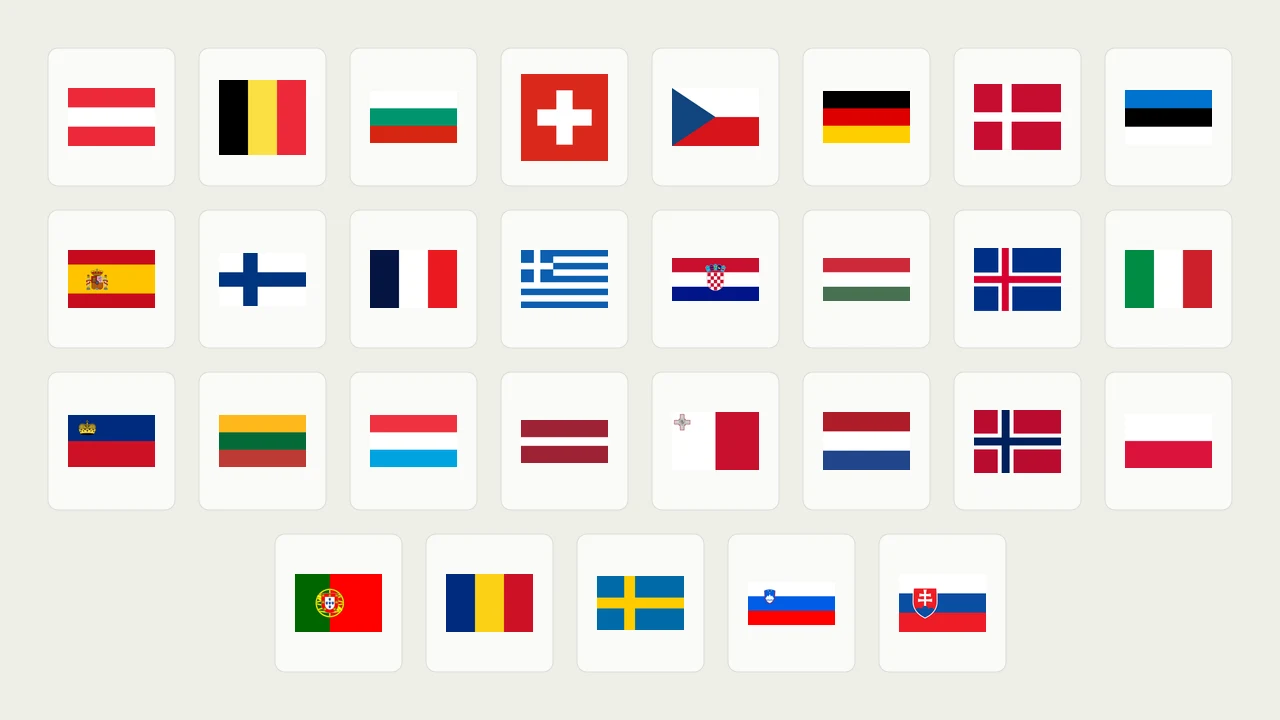
29 / 29
Belgium, France, Germany, Luxembourg and the Netherlands signed in 1985. Checks between them were lifted only in 1995.
Iceland, Norway, Switzerland and Liechtenstein belong to Schengen without being EU members.
Denmark, Finland, Sweden, Norway and Iceland became part of the area without internal border checks in 2001.
Internal border checks were lifted with nine more countries in 2007.
Air and sea checks ended in 2024; land border checks were lifted on 1 January 2025.
The agreement was signed in 1985 and the convention in 1990. Internal checks were first lifted in 1995.
The year on each card marks the lifting of internal border checks; for Bulgaria and Romania it marks full implementation at land borders in 2025.
There are 29: 25 EU members and four non-EU countries.
Iceland, Norway, Switzerland and Liechtenstein.
No. Ireland is outside the area, and internal border checks with Cyprus have not yet been lifted.
Internal border checks involving Finland were lifted in 2001.
The EU is a political and economic union. Schengen is an area based on the removal of internal border checks and includes four non-EU countries.
Bulgaria and Romania on 1 January 2025, when checks at their internal land borders were lifted.
No. Temporary internal border checks can be reintroduced under specified conditions, and travel documents may still be needed.