What do the nine stripes represent?
They are commonly linked with the nine syllables of Eleftheria i Thanatos, the independence-era motto “Freedom or Death”.


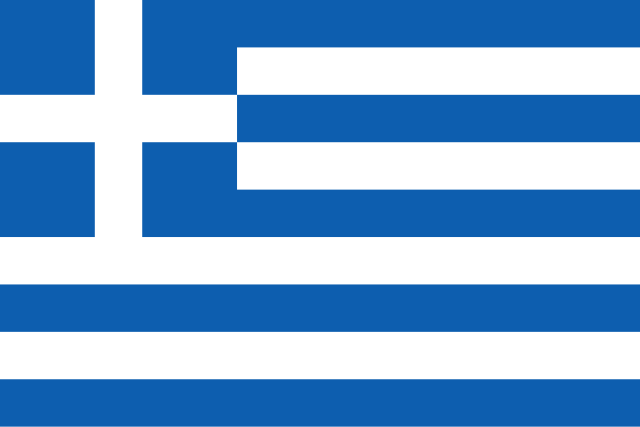
Greece's flag has nine equal horizontal stripes, alternating blue and white, with blue at the top and bottom.

Greece
9 equal-width horizontal bands.
Greece's flag has nine alternating blue and white horizontal bands and a white cross in a blue canton. The cross refers to Greek Orthodox Christianity and has been part of Greek flag symbolism since the independence struggle. Blue and white are national colours commonly associated with the Greek sky and sea.
A widespread explanation links the nine bands with the nine syllables of the Greek motto Eleftheria i Thanatos, “Freedom or Death”. This interpretation connects the striped design with the War of Independence, although it should be understood as the customary explanation given in the Finnish source.
A blue canton at the hoist contains a white cross; it spans the height of the first five stripes. The Presidential source describes this layout without assigning legal meanings to each colour.
The design brings together the cross, a longstanding emblem of Greek Orthodoxy, and the striped maritime flag. The Presidency of the Republic traces their union to 1828. This historical account explains the composition, but does not establish a single later adoption date for the present national flag.
They are commonly linked with the nine syllables of Eleftheria i Thanatos, the independence-era motto “Freedom or Death”.
There are nine equal horizontal stripes, alternating blue and white.
A white cross is placed in the blue canton at the hoist, across the height of the first five stripes.
The Presidency traces their union to 1828; that historical note is not a stated adoption date for today's flag.
These flags come from the same region and share one or more design characteristics.
Images are ordered by the years listed in the collection. A listed year may not be the flag’s official adoption year.
Vexilla's historical flag collection includes former flags associated with present-day countries and territories, as well as flags of states, empires, and other authorities that historically governed them.
A flag's inclusion in a country's historical collection does not necessarily mean that the country was independent at the time or that the flag was its own national flag.
The years shown are based on historical records in the dataset and do not always indicate the date of official adoption. The collection is not exhaustive, and historical usage, territorial coverage, and interpretations may vary.


